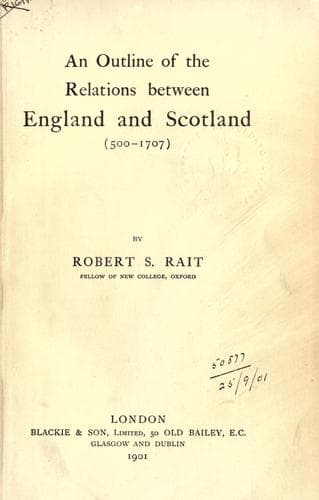
An Outline of the Relations between England and Scotland (500-1707)Rait, Robert S. (Robert Sangster)
History
An Outline of the Relations between England and Scotland (500-1707)
Rait, Robert S. (Robert Sangster)
England -- Foreign relations -- Scotland; Scotland -- Foreign relations -- England
The first blow in the renewed struggle was struck at Methven, near
Perth, where, on the 19th June, 1306, the Earl of Pembroke inflicted a
defeat upon King Robert. The Lowlands were now almost entirely lost to
him; he sent his wife[47] and child to Kildrummie Castle in
Aberdeenshire, whence they fled to the sanctuary of St. Duthac, near
Tain. In August, Bruce was defeated at Dalry, by Alexander of Lorn, a
relative of the Comyn. In September, Kildrummie Castle fell, and Nigel
Bruce, King Robert's brother, fell into the hands of the English and was
put to death at Berwick. To complete the tale of catastrophes, the
Bruce's wife and daughter, two of his sisters, and other two of his
brothers, along with the Countess of Buchan, came into the power of the
English king. Edward placed some of the ladies in cages, and put to
death Sir Thomas Bruce and Alexander Bruce, Dean of Glasgow (February,
1306-7). Meanwhile, King Robert had found it impossible to maintain
himself even in his own lands of Carrick, and he withdrew to the island
of Rathlin, where he wintered. Undeterred by this long series of
calamities, he took the field in the spring of 1307, and now, for the
first time, fortune favoured him. On the 10th May, he defeated the
English, under Pembroke, at Loudon Hill, in Ayrshire. He had been joined
by his brother Edward and by the Lord James of Douglas (the "Black
Douglas"), and the news of his success, slight as it was, helped to
increase at once the spirit and the numbers of his followers. His
position, however, was one of extreme difficulty; he was still only a
king in name, and, in reality, the leader of a guerilla warfare. Edward
was marching northwards at the head of a large army, determined to crush
his audacious subject. But Fate had decreed that the Hammer of the Scots
was never again to set foot in Scotland. At Burgh-on-Sand, near
Carlisle, within sight of his unconquered conquest, the great Edward
breathed his last. His death was the turning-point in the struggle. The
reign of Edward II in England is a most important factor in the
explanation of Bruce's success.
Public-domain text, read in full here on John Shaqi.
Reviews
Reviews
No reviews yet
Be the first to share your thoughts on this work.
Join the Discussion
Join the discussion
Sign in to leave a comment or review.
Sign InorCreate an account