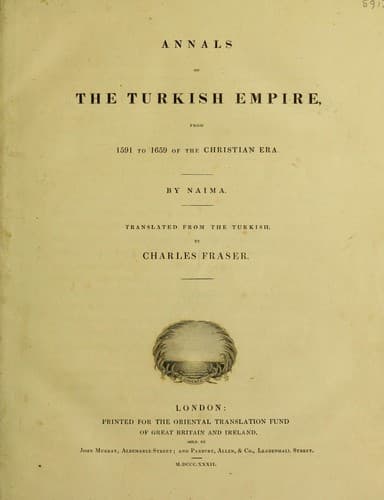
Annals of the Turkish Empire, from 1591 to 1659 — John Shaqi
Annals of the Turkish Empire, from 1591 to 1659Naima, Mustafa
History
Annals of the Turkish Empire, from 1591 to 1659
Naima, Mustafa
Turkey -- History -- 1453-1683
After all these things were once over, the remains of the late emperor
were carried into the area of the palace, when Khoja Sa’d-ud-dín
Effendí said, “We are now assembled to perform the last duty, to our
late Emperor,” and then requested permission to perform the funeral
rites. Ferhád Páshá obtained this permission for him from the new
emperor. But before he and the reverend prelate had time to come out
from the royal presence, the Muftí, Bostán Zádeh, in virtue of his
office, proudly arrogated to himself this honour, and without further
ceremony commenced performing the obsequies in question. When Sa’d ud
dín Effendí saw this he was greatly displeased, and said, “The relation
of the dead, the chief mourner, granted me the permission of performing
what you, the Muftí, have taken upon yourself to do. It is right
and proper to perform the service over again.” The Muftí, in reply,
observed, “that it was the permission of the Lord of the whole universe
he possessed, and therefore that what the other demanded was not only
unnecessary, but prohibited him from attempting it.” This circumstance
was afterwards the cause of much ill will and strife between these two
reverend divines.
After this unpleasant discussion between the two prelates respecting
the right of performing the funeral obsequies over the remains of
the deceased emperor was finally ended, his Majesty, the Asylum of
the World, returned to the royal harem, leaving his vezírs and other
grandees to accompany the bier of his father to the vicinity of St.
Sophia, where they interred it in a tomb previously prepared.
In a tumult which had taken place on this occasion, nineteen brothers
of the emperor, all innocent and guiltless, were strangled and added to
the company of martyrs. Early next morning the reverend Muftí performed
the customary prayers over these martyred bodies, which were afterwards
interred in a grave at the foot of their father’s tomb.
_The late Emperor’s age.—The time of his reign.—Some of his virtues and
good deeds described._
Sultán Murád Khán was fifty years old when he died, and reigned a
little more than twenty years. He was the father of one hundred and
two sons. Four of those princes who suffered martyrdom, namely, Sultán
Mustafa, Sultán Báyazíd, Sultán Osmán, and Sultán Abdullah were the
most distinguished, and were all of them instructed in the doctrines of
Nawa Effendí. The others, too, were all graceful and virtuous. Sultán
Mustafa was a man of an extensive genius, and a great orator. The
glorious parent of these princes when despairing of life repeated the
following lines:
“What the Almighty Notary has written on my forehead, I know not;
“Alas! I have never smiled in the rose-bower of this world.”[4]
Public-domain text, read in full here on John Shaqi.
Reviews
Reviews
No reviews yet
Be the first to share your thoughts on this work.
Join the Discussion
Join the discussion
Sign in to leave a comment or review.
Sign InorCreate an account