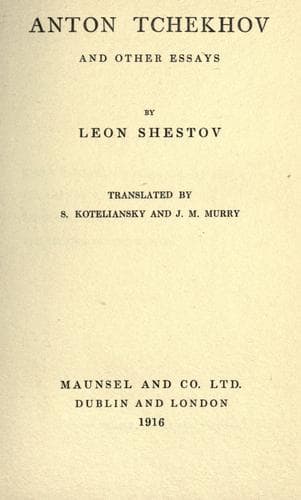
Chekhov, Anton Pavlovich, 1860-1904; Dostoyevsky, Fyodor, 1821-1881; Philosophy; Russian literature -- History and criticism
In _Ivanov_ the hero compares himself to an overstrained labourer. I
do not believe we shall be mistaken if we apply this comparison to the
author of the drama as well. There can be practically no doubt that
Tchekhov had overstrained himself. And the overstrain came not from
hard and heavy labour; no mighty overpowering exploit broke him: he
stumbled and fell, he slipped. There comes this nonsensical, stupid,
all but invisible accident, and the old Tchekhov of gaiety and mirth
is no more. No more stories for _The Alarm Clock._ Instead, a morose
and overshadowed man, a 'criminal' whose words frighten even the
experienced and the omniscient.
If you desire it, you can easily be rid of Tchekhov and his work as
well. Our language contains two magic words: 'pathological,' and its
brother 'abnormal.' Once Tchekhov had overstrained himself, you have a
perfectly legal right, sanctified by science and every tradition, to
leave him out of all account, particularly seeing that he is already
dead, and therefore cannot be hurt by your neglect. That is if you
desire to be rid of Tchekhov. But if the desire is for some reason
absent, the words 'pathological' and 'abnormal' will have no effect
upon you. Perhaps you will go further and attempt to find in Tchekhov's
experiences a criterion of the most irrefragable truths and axioms of
this consciousness of ours. There is no third way: you must either
renounce Tchekhov, or become his accomplice.
The hero of _The Tedious Story_ is an old professor; the hero of
_Ivanov_ a young landlord. But the theme of both works is the same.
The professor had overstrained himself, and thereby cut himself off
from his past life and from the possibility of taking an active part
in human affairs. Ivanov also had overstrained himself and become a
superfluous, useless person. Had life been so arranged that death
should supervene simultaneously with the loss of health, strength and
capacity, then the old professor and young Ivanov could not have lived
for one single hour. Even a blind man could see that they are both
broken and are unfit for life. But for reasons unknown to us, wise
nature has rejected coincidence of this kind. A man very often goes on
living after he has completely lost the capacity of taking from life
that wherein we are wont to see its essence and meaning. More striking
still, a broken man is generally deprived of everything except the
ability to acknowledge and feel his position. Nay, for the most part
in such cases the intellectual abilities are refined and sharpened
and increased to colossal proportions. It frequently happens that an
average man, banal and mediocre, is changed beyond all recognition when
he falls into the exceptional situation of Ivanov or the old professor.
In him appear signs of a gift, a talent, even of genius. Nietzsche once
asked: 'Can an ass be tragical?' He left his question unanswered, but
Tolstoi answered for him in _The Death of Ivan Ilyich._ Ivan Ilyich,
Public-domain text, read in full here on John Shaqi.
Reviews
Reviews
No reviews yet
Be the first to share your thoughts on this work.
Join the Discussion
Join the discussion
Sign in to leave a comment or review.
Sign InorCreate an account