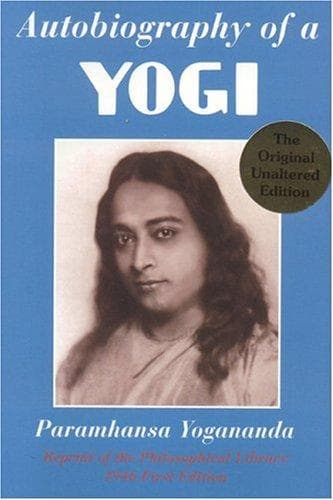
Yogananda, Paramahansa, 1893-1952; Yogis -- India -- Biography
Father, Bhagabati Charan Ghosh, was kind, grave, at times stern.
Loving him dearly, we children yet observed a certain reverential
distance. An outstanding mathematician and logician, he was guided
principally by his intellect. But Mother was a queen of hearts,
and taught us only through love. After her death, Father displayed
more of his inner tenderness. I noticed then that his gaze often
metamorphosed into my mother’s.
In Mother’s presence we tasted our earliest bitter-sweet acquaintance
with the scriptures. Tales from the MAHABHARATA and RAMAYANA {FN1-6}
were resourcefully summoned to meet the exigencies of discipline.
Instruction and chastisement went hand in hand.
A daily gesture of respect to Father was given by Mother’s dressing us
carefully in the afternoons to welcome him home from the office.
His position was similar to that of a vice-president, in the
Bengal-Nagpur Railway, one of India’s large companies. His work
involved traveling, and our family lived in several cities during
my childhood.
Mother held an open hand toward the needy. Father was also kindly
disposed, but his respect for law and order extended to the budget.
One fortnight Mother spent, in feeding the poor, more than Father’s
monthly income.
“All I ask, please, is to keep your charities within a reasonable
limit.” Even a gentle rebuke from her husband was grievous to Mother.
She ordered a hackney carriage, not hinting to the children at any
disagreement.
“Good-by; I am going away to my mother’s home.” Ancient ultimatum!
We broke into astounded lamentations. Our maternal uncle arrived
opportunely; he whispered to Father some sage counsel, garnered
no doubt from the ages. After Father had made a few conciliatory
remarks, Mother happily dismissed the cab. Thus ended the only trouble
I ever noticed between my parents. But I recall a characteristic
discussion.
“Please give me ten rupees for a hapless woman who has just arrived
at the house.” Mother’s smile had its own persuasion.
“Why ten rupees? One is enough.” Father added a justification: “When
my father and grandparents died suddenly, I had my first taste of
poverty. My only breakfast, before walking miles to my school, was
a small banana. Later, at the university, I was in such need that
I applied to a wealthy judge for aid of one rupee per month. He
declined, remarking that even a rupee is important.”
“How bitterly you recall the denial of that rupee!” Mother’s heart
had an instant logic. “Do you want this woman also to remember
painfully your refusal of ten rupees which she needs urgently?”
“You win!” With the immemorial gesture of vanquished husbands, he
opened his wallet. “Here is a ten-rupee note. Give it to her with
my good will.”
Public-domain text, read in full here on John Shaqi.
Reviews
Reviews
No reviews yet
Be the first to share your thoughts on this work.
Join the Discussion
Join the discussion
Sign in to leave a comment or review.
Sign InorCreate an account