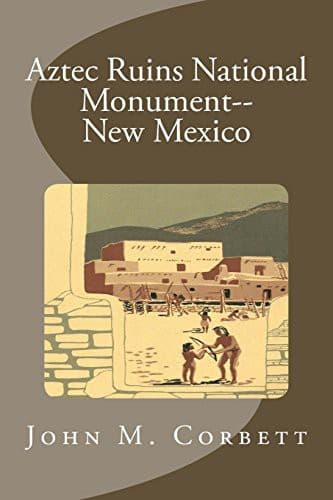
Aztec Ruins National Monument, New MexicoCorbett, John M. (John Maxwell)
History
Aztec Ruins National Monument, New Mexico
Corbett, John M. (John Maxwell)
Aztec Ruins National Monument (N.M.)
Basketmaker remains are found throughout the Four Corners country, the
better specimens being recovered from dry caves where the more
perishable materials are preserved. In open sites, only the stone and
bone objects are left, along with the remains of house structures and
storage pits.
In the Animas Valley, north of Durango, Colo., there was quite a
concentration of early Basketmakers. Earl H. Morris, who conducted the
first scientific explorations of Aztec Ruins, excavated a number of
these sites in 1938 and 1939. Here, in an open talus site, he found the
first evidence that the early Basketmakers had actual house structures.
He gives a graphic description of a typical one:
A site for the dwelling was secured by digging a drift into the steep
hillside and piling the excavated earth and stone out in front until a
terrace large enough to accommodate the projected house had been
provided. The floor area was scooped out to shallow saucer shape—in
this case 9 m. in diameter—and coated with mud. At the margins, the
mud curved upward to end against the half-buried foot logs which were
the basal course of the wall. The walls were composed of horizontal
wood and mud masonry. They rose with an inward slant to a little
better than head height, then were cribbed for a distance to reduce
the diameter of the flat portion of the roof, which was of clay
supported by parallel poles. The arc of stones was a retaining device
placed to hold back the ever-growing accumulation of refuse that was
dumped at the brink of the terrace.
Interior furnishings generally consisted of a heating-pit, slab-lined
storage cists, some with above-floor mud domes, and usually grinding
stones and metates. How such a structure was entered is not known;
possibly it was through a smoke hole in the roof, as in the later and
deeper pithouses, or perhaps it was through a lateral doorway with a
high sill, traces of which no longer remain.
By A.D. 700, the Four Corners country was evidently well populated. In
this later part of the Basketmaker period, the houses in open sites were
usually more subterranean. These later houses, often with slab-lined and
adobe-plastered walls, had a smaller second room or antechamber added on
the front through which entrance was made. A few such ruined dwelling
sites are known along the Animas River south of Durango. Morris felt
that an adequate archeological survey would reveal a great many more,
but extensive plowing of the area in recent historic times has long
since removed the evidence. In the latter part of this period, the early
Basketmakers evidently moved downstream where there was better land for
cultivation and the growing season was slightly longer.
Public-domain text, read in full here on John Shaqi.
Reviews
Reviews
No reviews yet
Be the first to share your thoughts on this work.
Join the Discussion
Join the discussion
Sign in to leave a comment or review.
Sign InorCreate an account