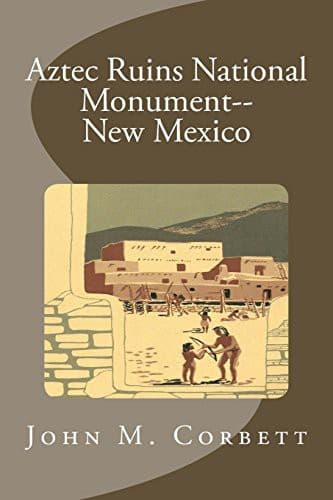
Aztec Ruins National Monument, New MexicoCorbett, John M. (John Maxwell)
History
Aztec Ruins National Monument, New Mexico
Corbett, John M. (John Maxwell)
Aztec Ruins National Monument (N.M.)
The Basketmakers used clothing of a sort; that is, they may have worn a
loincloth or apron and probably had shoulder robes of untailored tanned
hide for protection against cold. Woven bands or loincloths have been
found in several sites. Most burials had no type of clothes but
sometimes were wrapped in mantles or dried skins. Probably clothing was
never worn very much. Certain “aprons” attached to waist cords and made
of strings of cedar or yucca bast were evidently used as menstrual pads.
Finely woven aprons may have been worn by the women on special
“dress-up” occasions, but the scarcity of such items would indicate they
were not for everyday wear.
They wore sandals made of woven yucca strips or cleaned fibers, or
sometimes of very fine cross-woven cord, with fringed toes and colored
ornamentation. Human hair was used in making rope in considerable
quantities; either it was cut off after death and utilized for this
purpose, or was hacked short from time to time during life. Some
burials, especially among the males, indicate rather fancy hair styles,
and it may, therefore, have been the women who had their hair cropped to
supply the material for ropes and belts.
Both men and women wore ornaments—bracelets, necklaces, and pendants
fashioned of stone, bone, or even various dried berries. Beads were also
made of _olivella_, _conus_, and abalone shell which probably were
imported from the Pacific Coast by trading with intervening tribes. Fur
blankets were fashioned by wrapping yucca-fiber strings with long narrow
strips of rabbit fur and tying these fur-covered strings together in
close parallel rows.
The Basketmakers were especially known for the fine types of woven
containers they produced. Flexible seamless sacks, beautifully decorated
in black, red-brown, and gray are sometimes found. Large, wide-mouthed
ovoid baskets, carried on the back with the aid of a tumpline across the
forehead, were used for bringing home seeds and other crops. Basket
trays and bowls, with both close coiling and spaced coiling, were often
highly ornamented, always in a symmetrical pattern. Designs usually
consist of red figures outlined with black, alternating with black
figures outlined in red.
The women ground corn on metates—flat slabs of rock in which eventually
a deep groove was worn—with manos, or small hand stones. Stone of
various sorts was used in making spear and dart points (and in the later
part of the period, arrow points), knives, drills, gravers, pipes, and
atlatl weights. Animal bone was carefully fashioned into awls, fleshers,
scrapers, whistles, jewelry, and even gaming pieces. Wood was used for
the atlatl and the dart, and later for bows and arrows, for digging
sticks (for planting crops), scoops, feather boxes, and hair ornaments.
Public-domain text, read in full here on John Shaqi.
Reviews
Reviews
No reviews yet
Be the first to share your thoughts on this work.
Join the Discussion
Join the discussion
Sign in to leave a comment or review.
Sign InorCreate an account