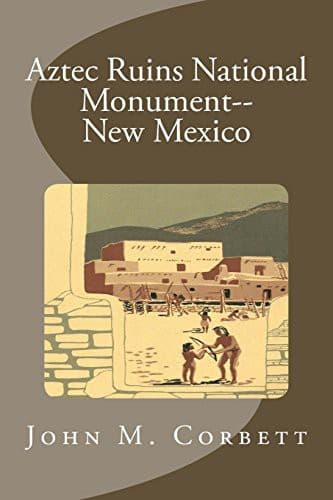
Aztec Ruins National Monument, New Mexico — John Shaqi
Aztec Ruins National Monument, New MexicoCorbett, John M. (John Maxwell)
History
Aztec Ruins National Monument, New Mexico
Corbett, John M. (John Maxwell)
Aztec Ruins National Monument (N.M.)
That they had a firm belief in a life in the hereafter is shown by the
care with which they buried their dead and by the offerings placed with
them. It is with these burials in dry caves that most of the perishable
material relating to this period has been found. Frequently the bodies
were wrapped in mantles of fur or feather string, and sometimes wrapped
again in the tanned skins of deer or mountain sheep. Often the bodies
have sandals on the feet (and occasionally an extra pair for replacement
if the first wore out) and are accompanied by hair ornaments, necklaces,
beads, pendants, baskets of corn and pinyon nuts, pipes and smoking
material, gaming sets, flutes, and implements of warfare and the chase.
The bodies were usually buried in the flexed position, that is, with the
knees drawn up tightly and the hands folded across the chest. In the
earlier part of the period, cave storage pits were used as burial
places. Some bodies were placed in crevices behind fallen rocks within
the cave. Other burials were in the open or in the talus slopes below
the caves. In the latter part of the period, so much of the cave was
used by the living that the dead were frequently buried in the open in
specially dug pits. In these cases, evidence of the perishable material
has usually disappeared. In a few of the later graves, pottery is found
as a grave offering. Morris reports one burial of this period that
contained 11 pottery vessels.
The Basketmakers must have had warm feelings of affection for their
young. There was a high mortality rate among the infants and children,
but despite this they lavished great care on each small burial. Children
might be buried in baskets or in large skin bags, but babies were
carefully buried in their cradles. These cradles were made by bending a
long slender stick into an oval shape, on which a framework of rods was
tied to the outer oval in a crisscross pattern. The interior was padded
with juniper bark and covered with fur-cloth blankets, which were often
made from the soft, white stomach skins of rabbits. The cradle could be
carried on the mother’s back, hung from a convenient peg in the home or
on a tree branch when out of doors, or laid carefully on the ground in
the shade, all without upsetting the baby. Diapers were made of soft
shredded juniper bark, and juniper bark pads wrapped in soft skins were
tied on the infants to prevent umbilical hernia.
Public-domain text, read in full here on John Shaqi.
Reviews
Reviews
No reviews yet
Be the first to share your thoughts on this work.
Join the Discussion
Join the discussion
Sign in to leave a comment or review.
Sign InorCreate an account