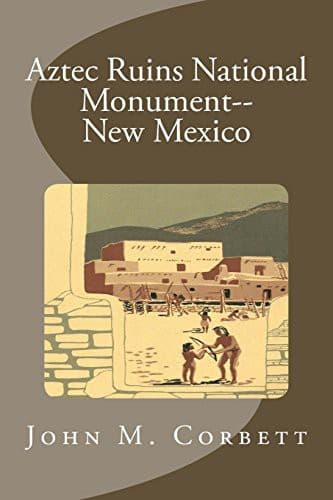
Aztec Ruins National Monument, New MexicoCorbett, John M. (John Maxwell)
History
Aztec Ruins National Monument, New Mexico
Corbett, John M. (John Maxwell)
Aztec Ruins National Monument (N.M.)
Although some of the rooms and walls seen by the first white settlers in
the valley have now collapsed, evidence of at least three stories is
still clearly visible in several places in the ruin. The main part
consists of three sides of a rectangle with a slightly bowing outer wall
on the fourth side, composed of single rooms, which seals off the
central plaza. The only entrance into the pueblo was the one along the
path by which visitors enter the ruin today.
The pueblo was built of yellowish-brown and tan sandstone blocks, most
of them shaped into rectangles by pecking or grinding. To support the
weight of the upper rooms, the lower walls are much thicker and are
composed of rubble fill with an outer veneer wall of the better shaped
rectangular blocks. In many places, the spaces between them are filled
with small chinking stones set in adobe mud. Sometimes broken pieces of
pottery vessels were used for spalls. Originally, the walls were
plastered with layers of adobe, most of which, unfortunately, have
eroded away.
[Illustration: Section of wall at Aztec Ruins showing a band of green
sandstone.]
One unusual feature in the West Ruin consists of two very fine bands of
green sandstone blocks which extend horizontally along the west outer
wall of the pueblo and into a few of the interior rooms of the southwest
corner. There are indications in a few places that originally there may
have been three such parallel bands.
The north and northwest sides of the ruin contain the most extensive
building remains. The highest walls and best construction still exist
there, and one can see evidence of at least three stories. Also in the
north portion, along the extreme back row of rooms at the ground level,
there is a series of seven rooms, each of which has its original ceiling
intact. These seven were the first entered by early relic hunters, who
found most of the original doorways to the south sealed up and who broke
through the walls of each room in an easterly direction. These breaches
in the walls have been repaired but left open, so that today you can go
from one room to the next along the path taken by the early explorers
rather than through the doorways used by the Indians.
From the plaza, the Indians gained access to these northwestern rooms by
entering the west side rooms. Then, turning at right angles, they
proceeded northward through the doorways and rooms until they reached
the final row of rooms at the north.
Public-domain text, read in full here on John Shaqi.
Reviews
Reviews
No reviews yet
Be the first to share your thoughts on this work.
Join the Discussion
Join the discussion
Sign in to leave a comment or review.
Sign InorCreate an account