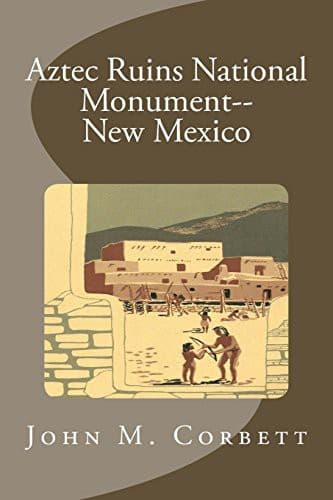
Aztec Ruins National Monument, New Mexico — John Shaqi
Aztec Ruins National Monument, New MexicoCorbett, John M. (John Maxwell)
History
Aztec Ruins National Monument, New Mexico
Corbett, John M. (John Maxwell)
Aztec Ruins National Monument (N.M.)
But as they became more dependent upon corn and added the cultivation of
squash, these people discovered that two things are necessary for a
group dependent upon agriculture: one, that most of the group has to
remain nearby while the crop is planted, matured, and harvested (to
protect it from rodents, deer, birds, and, probably, marauding tribes);
second, that there must be a secure storage place for the surplus food
and the seeds for next year’s crop. This latter requirement forced them
to build storage pits lined with stone slabs, bark, and adobe which
could be securely covered so that rodents and insects would not eat the
surplus harvest.
Archeologists have long called these early inhabitants of the area
“Basketmakers” because of the variety of beautiful baskets and sandals
which they wove from fibrous plant materials. In the earlier part of
this period, they did not know how to make or use pottery, and baskets
were important as storage containers or as vessels in which to cook by
stone boiling. Although their descendants also made and used baskets,
they never achieved the fine quality and artistry of the early
Basketmakers.
Archeologists divide this Basketmaker phase into an early period of
about 400 years and a later period (sometimes referred to as “Modified
Basketmaker”) of about 350 years. The Modified Basketmakers had several
important traits which the earlier ones lacked: namely, the bow and
arrow, which replaced the atlatl (throwing stick); beans, which added
important protein to the diet; and a knowledge of how to make pottery,
which permitted much easier cooking and better storage of perishables.
The necessity for an assured food supply was of increasing importance,
for there was a slowly but steadily growing population. Agriculture
provided such a supply and freed a part of the population from
subsistence activities, giving them leisure to devote to pursuits which
were not necessary for mere existence. For example, turquoise—worked and
polished into ornamental jewelry—seems to have been first used at this
time. Small crude pottery figurines are also found, indicating a growing
interest in religion and an increasing awareness of religious ideas.
Kivas—developed from the idea of the older pithouse—first appear in this
period. These provided a place for the performance of religious
ceremonies and other nonsecular functions. The men evidently had the
time to meet in council and debate communal problems. While the family
unit was still important, the clan and even the entire community took on
new important aspects of “togetherness.”
We do know what these people looked like, since quite a few
well-preserved “mummies” have been found buried in dry caves. They were
short, averaging 5 feet 3 or 4 inches for the men and about 5 feet for
the women. Their general build was medium slender to stocky; their faces
moderately long and narrow; skin color was light to dark brown; and
their eyes were brown to black, as was their hair.
Public-domain text, read in full here on John Shaqi.
Reviews
Reviews
No reviews yet
Be the first to share your thoughts on this work.
Join the Discussion
Join the discussion
Sign in to leave a comment or review.
Sign InorCreate an account