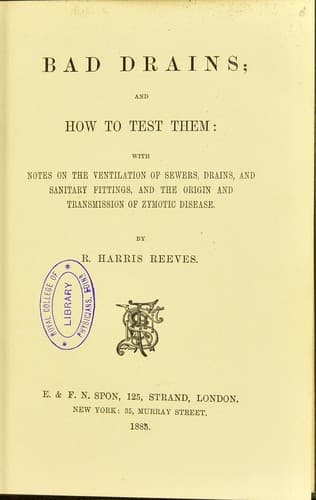
Bad Drains; and How to Test Them: With notes on the ventilation of sewers, drains, and sanitary fittings, and the origin and transmission of zymotic diseaseReeves, R. Harris
Science
Bad Drains; and How to Test Them: With notes on the ventilation of sewers, drains, and sanitary fittings, and the origin and transmission of zymotic disease
Reeves, R. Harris
Sewerage
The last improvement suggested to give a better system of sewer
ventilation in the City is the erection of shafts at the sides of the
buildings where possible. A resolution was passed last year by the City
Commissioners of Sewers to erect these shafts where practicable. The
effect of this alteration will be to remove the nuisance from the street
and carry it to a higher level. If it is intended to work these shafts
in conjunction with the open gratings, the effect will be that in some
streets the whole of the gas from the sewers adjoining will be pouring
out of one shaft. In the summer time its density will be increased by
the friction in the shafts, and the high temperature of the atmosphere
will cause a more rapid decomposition in the sewage.
In low buildings or warehouses there is nothing to prevent the poisons
from the sewers from being conveyed down the chimneys into the
buildings, and the employés taking a zymotic disease whilst engaged in
their work and at night taking it to various parts of the suburbs.
It is better to let the gas escape at a low level, where it could be
purified when it is a nuisance, and especially in the case of an
epidemic, than discharge gas with a greater density at a higher level.
The General Board of Health in 1848 issued the following minutes of
information with reference to sewers and house drains—
“Make proper provision for the ventilation of sewers and drains in such
a manner that there may be a free current of air in them in the
direction of the sewage flow.”
It was also recommended “that the stack pipes should be connected with
the sewers without the intervention of traps, in order to assist the
ventilation, and there should be no trap between the trap at the inlet
and the sewer.”
This system was found far worse than the open gulleys or shoots in the
City in 1830, as at Croydon (which was one of the first towns to carry
out works of sewage under the General Board of Health) no sooner had the
sewers been in use before an outbreak of fever took place.
Dr. Niell Arnott and Mr. T. Page, C.E., were appointed by the Home
Secretary to report on the outbreak at Croydon, and Mr. Page in his
report states—
“Whenever a water-closet even with the best form of siphon trap is
introduced into a house, it will be well to provide an escape into the
open air. When several soil-pans or sinks from the apartments of a large
house are discharged into a common soil-pipe or vertical main, the main
should be continued up to the roof and to the open air, and if
practicable it should be carried near the chimney. Pipe sewers must also
have ample ventilation provided at all available points. If the air is
confined it is most dangerous when it breaks forth, which sooner or
later it will do, such evils would have been avoided.”
Public-domain text, read in full here on John Shaqi.
Reviews
Reviews
No reviews yet
Be the first to share your thoughts on this work.
Join the Discussion
Join the discussion
Sign in to leave a comment or review.
Sign InorCreate an account