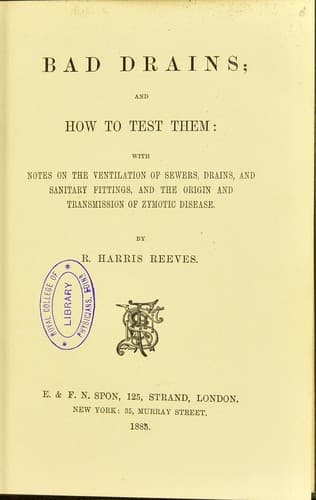
Bad Drains; and How to Test Them: With notes on the ventilation of sewers, drains, and sanitary fittings, and the origin and transmission of zymotic diseaseReeves, R. Harris
Science
Bad Drains; and How to Test Them: With notes on the ventilation of sewers, drains, and sanitary fittings, and the origin and transmission of zymotic disease
Reeves, R. Harris
Sewerage
It is quite evident by these remarks that the system of ventilating the
City sewers in 1830 was more perfect than at Croydon, and had Mr. Page
tested the sewers and sanitary fittings by the compression of gases in
them, he would have found that the action of the water in the pipe
prevented the gas from being confined.
In 1858, Mr. Goldsworthy Gurney made experiments in the neighbourhood of
the House of Commons by connecting a number of the sewers near with the
furnace of the clock-tower, and this was reported on by Sir Joseph
Bazalgette as follows:—
“I find that the furnace of the clock-tower of the House of Parliament
was supposed to have been connected with the adjoining district to the
extent of about a quarter of a square mile, and with about 6½ miles of
sewers, but that the ventilation had in reality been intercepted by a
flap so that the benefit supposed to be derived therefrom was purely
imaginary. Having come to that conclusion, the next thing I directed my
attention to was, supposing the whole of the air extracted by that
furnace was produced from the sewers, and supposing that all the
intermediate channels could be stopped, and that it could be directed
from the most remote ends of each of the sewers, and distributed over
those sewers with the most perfect theoretical accuracy, so as to have
uniform currents passing through each of the sewers towards that
chimney, still the effect on those sewers would be nothing, and the way
in which I prove my statement is this: the total area of the 6½ miles of
sewers now connected with the furnace is 713 feet, the total area of the
channel through which the air has to be brought from them is 8 feet,
that is about the ninetieth part of 713; the air was passing at the rate
of 542 feet per minute through the 8 feet area. Therefore, if I could
divide that over the whole district, the velocity in all those sewers
would be 6 feet per minute or ⅕ of a mile per hour. But we have shown
already that there exist in the sewers from other causes velocities
amounting to 100 feet per minute and upwards; and 6 feet per minute is
practically speaking stagnation and not ventilation.”
Public-domain text, read in full here on John Shaqi.
Reviews
Reviews
No reviews yet
Be the first to share your thoughts on this work.
Join the Discussion
Join the discussion
Sign in to leave a comment or review.
Sign InorCreate an account