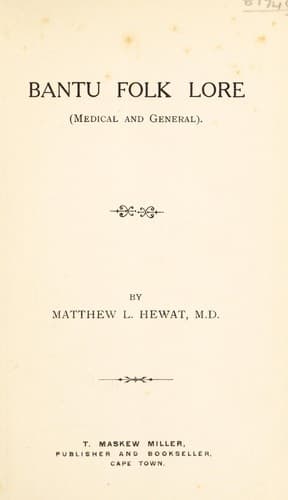
Bantu Folk Lore (Medical and General) — John Shaqi
Bantu Folk Lore (Medical and General)Hewat, Matthew L.
Science
Bantu Folk Lore (Medical and General)
Hewat, Matthew L.
Pondo (African people); Traditional medicine -- South Africa; Xhosa (African people); Zulu (African people)
Rheumatism, Gout. Isi-dlanga or in-dubula. These are not differentiated
though fairly common, especially, however, amongst the natives who,
owing to their going at times near the European villages, are forced to
wear European costumes, usually terribly dilapidated. If called
in-dubula it is supposed to be ideopathic, due to natural causes, and
the name is that used to distinguish a small hairy insect, the patient
feeling as if it were this insect gnawing at his joints.
Treatment: In these cases one of the “Amgqira Awokuqubula” is called
in, and he, after rubbing etc., applies his mouth to the part and sucks
out the disease, spitting out one of these insects as proof of his
success. Or one of (Amagqira-awobulongo); cow-dung doctors, who
applying his cow-dung poultice with much ceremony, will when removing
it later, also produce an ocular proof of his having got away the
tormentor.
The Kaffirs have for generations been in the habit of using the leaves
of the Um-gcunube (Salix Capensis) or Cape river willow for the cure of
rheumatic pains. This is a curious fact, when one realizes that these
leaves are rich in “Salicin” the very drug used as a specific in modern
medicine.
Scrofula. I-hashe. This is a fairly common disease, looked upon as due
to bad blood or weak parents.
Treatment: A very large variety of herbs is used by the Amagqira
Awemiciza for this disease either as a paste to external manifestations
or internally in infusion. The best known are:—
Um-Bangandlela —Heteromorpha arborescens
Um-Pafa —Ziziphus mucronata
I-Yeza lehashe —Bulbine asphodeloides
I-Rubuxa —Pentanisia variabilis
Um-Sintsana —Erythrina Humei
Um-Tumana —Solanum Capense
I-Yeza lehashe (No. 2) Thunbergia Capensis
Each or all of these drugs, amongst others is used for I-hashe or if a
running sore (I-quita) Scrofula, multiple running swellings, or
enlarged glands.
Cancer. Isi-hlava or Um-hlaza a name given to all sores that refuse to
heal or continue to spread.
Mumps. Uqilikwana. The following curious practice is the only method of
treatment I can find. The sufferer finds the burrow of a hare and
stooping down, calls down the hole “Qilikwana! Qilikwana! Nika Kum”
(Mumps! Mumps! get away from me) and then walks straight home without
looking back. A cure follows in time!
C. TUMOURS AND NEW GROWTHS.
Ili-fa, plural Ama-fa, supposed to be collections of bad or useless
blood.
Treatment: When small they are pressed frequently by the teeth of a
menstruating or suckling woman. When large and having resisted this
last treatment they may be incised or even excised; (Treated by
Ukutyadwa, which means to cut open). If painful they are poulticed.
Boils. I-tumba are specially recognised and treated by poulticing. The
discharging pus is believed to be bad blood and its removal a great
good to the person’s system.
D. RESPIRATORY ORGANS.
Public-domain text, read in full here on John Shaqi.
Reviews
Reviews
No reviews yet
Be the first to share your thoughts on this work.
Join the Discussion
Join the discussion
Sign in to leave a comment or review.
Sign InorCreate an account