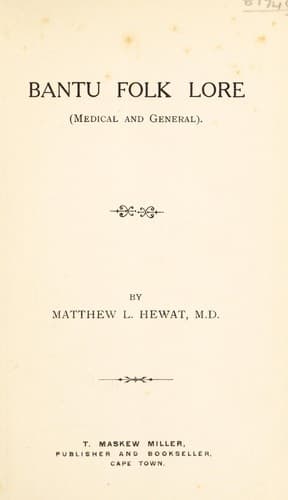
Bantu Folk Lore (Medical and General)Hewat, Matthew L.
Science
Bantu Folk Lore (Medical and General)
Hewat, Matthew L.
Pondo (African people); Traditional medicine -- South Africa; Xhosa (African people); Zulu (African people)
4. Ubu-hlungu besigcawu (Blepharis Capensis) is also used, as its name
implies for tarantula bite.
5. Isi-dikili (Lasiosiphon Meisneri) in doses of ½ oz. of dried root
often repeated. This plant is also used by the Gaikas as a gargle in
sore throat and a paste for open sores.
6. Ubu-hlungu benyoko (Acocanthera venenata) a very poisonous plant. A
small piece of the leaf is rubbed up in cold water and administered. It
produces violent vomiting. Several deaths are directly traceable to the
use of this highly dangerous plant.
Professor Sir T. Fraser of Edinburgh has extracted the active principle
of this and describes it (Acocantherine) as a glucoside, which
powerfully increases the systolic act of the heart, killing in this
way.
The Bushmen use this juice as an arrow poison.
7. Ubu lembu belitye (Parmelia conspersa) is a lichen. Scraped off the
rocks it is used for snake and other venomous bites.
8. Ili-bulawa. (Sebæa crassulæfolia) has been used with success in
recorded cases of puff-adder bite.
9. Um-nungumabele (Xanthoxylon Capense). A decoction of the tree root
is used.
There are also many others.
Kaffir beer is used as a stimulant in cases of collapse.
CHAPTER VI.
MIDWIFERY AND CHILDREN.
Childbirth is an exceedingly simple process, as a rule with the Kaffir;
a native woman only allowing it to interfere with her duties for a few
hours. Abnormal labours are seldom heard of.
Should any difficulty arise, a severe rubbing is sometimes resorted to
by the women in charge.
Whereas this statement holds good for the commonality and some tribes,
yet in others, e.g.: The Basutos, the time and method of childbirth is
very different.
The woman when near her time returns to the kraal of her father, who
pays the expenses if any, and of her mother, who is chief
superintendent of details. Some expert old women of the tribe acts as
midwife.
A special hut is built and kept carefully clean. On the floor is spread
a thick layer of dry cowdung to collect the lochia etc., and the woman
usually sits near this in a crouching position. She may, however, be on
her knees or even lying down. A firm band is tied above the uterus (to
keep it from rising) and this is tied lower down after the birth.
The child is received into the hands of an assistant; and the umbilical
cord, usually forcibly torn asunder several inches from the child’s
abdomen. The cord may, however, be cut or sometimes chewed through by
the midwife. The abdomen is, during the birth, rubbed and pressed, and
the back assisted by an assistant.
In very serious cases and only in extremis an Igqrira elemicisa is
called in, who however, seldom does much more than administer herbs.
To facilitate labour, and strengthen the uterine contractions, the
natives administer the root of the Um-kanzi (Typha latifolia).
Other herbs are used also for the purpose, one igqira being in the
habit of getting his patient stupefied by much smoking of dagga (Indian
hemp).
Public-domain text, read in full here on John Shaqi.
Reviews
Reviews
No reviews yet
Be the first to share your thoughts on this work.
Join the Discussion
Join the discussion
Sign in to leave a comment or review.
Sign InorCreate an account