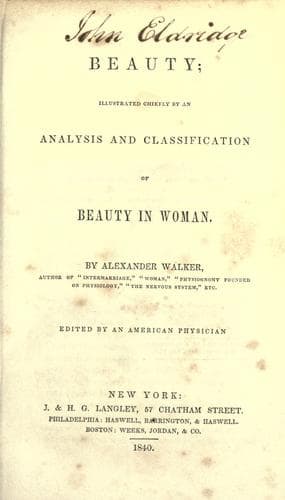
Beauty: Illustrated Chiefly by an Analysis and Classification of Beauty in WomanWalker, Alexander
Philosophy
Beauty: Illustrated Chiefly by an Analysis and Classification of Beauty in Woman
Walker, Alexander
Beauty, Personal; Women
Payne Knight shows that terror is even opposed to sublimity: "All the
great and terrible convulsions of nature; such as storms, tempests,
hurricanes, earthquakes, volcanoes, &c., excite sublime ideas, and impress
sublime sentiments by the prodigious exertions of energy and power which
they seem to display: for though these objects are, in their nature,
terrible, and generally known to be so, it is not this attribute of terror
that contributes, in the smallest degree to render them sublime.... Timid
women fly to a cellar, or a darkened room, to avoid the sublime effects of
a thunder-storm; because to them they are not sublime, but terrible. To
those only are they sublime, '_qui formidine nulla imbuti spectant_,' who
behold them without any fear at all; and to whom, therefore, they are in
no degree terrible."
This farther confirms the distinction which I made of beauty into minor or
subordinate, and grand or sublime beauty, although Knight adopted other
principles, if principles they may be called, and neglected such
distinction.
There is but one other error on this subject which I need to notice. Burke
says: "To make anything very terrible, obscurity seems in general to be
necessary. When we know the full extent of any danger, when we can
accustom our eyes to it, a great deal of the apprehension vanishes. Every
one will be sensible of this, who considers how greatly night adds to our
dread, in all cases of danger.... Those despotic governments which are
founded on the passions of men, and principally upon the passion of fear,
keep their chief as much as may be from the public eye. The policy has
been the same in many cases of religion. Almost all the heathen temples
were dark."
From what has already been said, it is evident that all this contributes
to terror, not to sublimity; and that the same error is made by Blair when
he says, "As obscurity, so disorder, too, is very compatible with
grandeur, nay, frequently heightens it."
To expose the weakness and to destroy the authority of some writers on
this subject, can only set the mind free for the investigation of truth.
I may, therefore, conclude this chapter by quoting the shrewd remarks of
Knight on some of the principles of Burke. I shall afterward be forced
critically to examine the notions of Knight in their turn.
Burke states that the highest degree of sublime sensation is astonishment;
and the subordinate degrees, awe, reverence, and respect; all which he
considers as modes of terror. And Knight observes that this graduated
scale of the sublime, from respect to astonishment, cannot, perhaps be
better illustrated than by applying it to his own character.
Public-domain text, read in full here on John Shaqi.
Reviews
Reviews
No reviews yet
Be the first to share your thoughts on this work.
Join the Discussion
Join the discussion
Sign in to leave a comment or review.
Sign InorCreate an account