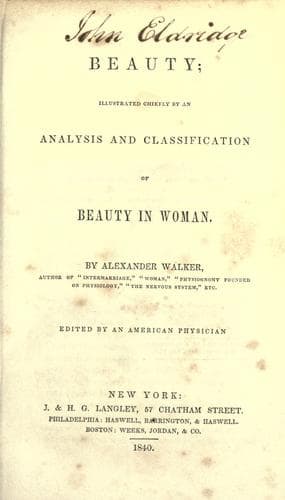
Beauty: Illustrated Chiefly by an Analysis and Classification of Beauty in WomanWalker, Alexander
Philosophy
Beauty: Illustrated Chiefly by an Analysis and Classification of Beauty in Woman
Walker, Alexander
Beauty, Personal; Women
"He was certainly," says Knight, "a very respectable man, and reverenced
by all who knew him intimately. At one period of his life, too, when he
became the disinterested patron of remote and injured nations, who had
none to help them, his character was truly sublime; but, unless upon those
whom he so ably and eloquently arraigned, I do not believe that it
impressed any awe.... If, during this period, he had suddenly appeared
among the managers in Westminster Hall without his wig and coat, or had
walked up St. James's street without his breeches, it would have
occasioned great and universal astonishment; and if he had, at the same
time, carried a loaded blunderbuss in his hands, the astonishment would
have been mixed with no small portion of terror: but I do not believe that
the united effects of these two powerful passions would have produced any
sentiment or sensation approaching to sublime, even in the breasts of
those who had the strongest sense of self-preservation and the quickest
sensibility of danger."
Thus, I believe, it now appears that novelty[10] is the exciting cause of
pleasurable emotion, and of the consequent perception of beauty in the
relations of things, and that the two genera of beauty--the minor or
subordinate beauty, and grandeur or sublimity--have distinct
characteristics, the confounding of which by writers has led to the
obscurity of this part of the subject.
CHAPTER V.
STANDARD OF TASTE IN BEAUTY.
The expression, "standard of taste," is used to signify the basis or
foundation of our judgments respecting beauty and deformity, and their
consequent certainty.
Setting aside such objection as might be raised to a standard of taste on
the doctrine of Berkeley (which I refuted in 1809, and which I need not
enter into here), this matter was long ago settled by David Hume; and I
have nothing new to say upon the subject (there is probably enough of
novelty in other chapters, whatever its worth may be), except that Burke
appears to have borrowed all he knew about it from that incomparably more
profound philosopher.
As I ought not, however, to omit here a view of the subject, I cannot do
better than transcribe the words of Hume and Burke respectively. While
this will put the reader in possession of all that I think necessary upon
this subject, it will farther tend to show in what Burke's ability as a
philosopher consisted.
I must first, however, observe that the word "taste," as expressing our
judgment of beauty, is a metaphor whimsically borrowed from the lowest of
our senses, and is applied to our exercise of that faculty, as regards
both natural objects, and the fine arts which imitate these.
It is not wonderful that the variety and inconstancy of tastes respecting
the attributes and the characters of beauty, should have led many
philosophers to deny that there exist any certain combinations of forms
and of effects to which the term beauty ought to be invariably attached.
Public-domain text, read in full here on John Shaqi.
Reviews
Reviews
No reviews yet
Be the first to share your thoughts on this work.
Join the Discussion
Join the discussion
Sign in to leave a comment or review.
Sign InorCreate an account