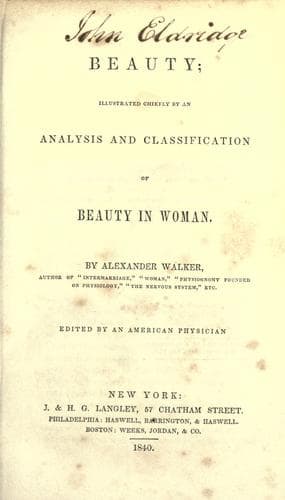
Beauty: Illustrated Chiefly by an Analysis and Classification of Beauty in Woman — John Shaqi
Beauty: Illustrated Chiefly by an Analysis and Classification of Beauty in WomanWalker, Alexander
Philosophy
Beauty: Illustrated Chiefly by an Analysis and Classification of Beauty in Woman
Walker, Alexander
Beauty, Personal; Women
In his "Philosophical Dictionary," Voltaire, after quoting some nonsense
from the crazy dreamer who did so much injury to Greek philosophy, says:
"I am willing to believe that nothing can be more beautiful than this
discourse of Plato; but it does not give us very clear ideas of the nature
of the beautiful. Ask of a toad what is beauty, pure beauty, the [Greek:
to kalon]; he will answer you that it is his female, with two large round
eyes projecting from her little head, a large and flat throat, a yellow
belly, and a brown back. Ask the devil, and he will tell you that the
beautiful is a pair of horns, four claws, and a tail. Consult, lastly, the
philosophers, and they will answer you by rigmarole: they want something
conformable to the archetype of the beautiful in essence, to the [Greek:
to kalon]." This is wit, not reason: let us look for that to a deeper
thinker--as proposed above.
David Hume says: "It appears that, amid all the variety and caprice of
taste, there are certain general principles of approbation or blame, whose
influence a careful eye may trace in all operations of the mind. Some
particular forms or qualities from the original structure of the internal
fabric, are calculated to please, and others to displease.... If they fail
of their effect in any particular instance, it is from some apparent
_defect_ or imperfection in the organ.
"In each creature there is a sound and a defective state; and the former
alone can be supposed to afford us a true standard of taste and sentiment.
If, in the sound state of the organ, there be an entire or a considerable
uniformity of sentiment among men, we may thence derive an idea of the
perfect beauty; in like manner as the appearance of objects in daylight,
to the eye of a man in health, is denominated their true and real color."
To the same purpose writes Burke, after some preliminary observations:--
"All the natural powers in man, which I know, that are conversant about
external objects, are the senses, the imagination, and the judgment.
"First, with regard to the senses. We do and we must suppose, that, as the
conformations of their organs are nearly or altogether the same in all
men, so the manner of perceiving external objects is in all men the same,
or with little difference.
"As there will be little doubt that bodies present similar images to the
whole species, it must necessarily be allowed, that the pleasures and the
pains which every object excites in one man, it must raise in all mankind,
while it operates naturally, simply, and by its proper powers only.
"Custom, and some other causes, have made many deviations from the natural
pleasures or pains which belong to these several tastes; but then the
power of distinguishing between the natural and the acquired relish
remains to the very last.
Public-domain text, read in full here on John Shaqi.
Reviews
Reviews
No reviews yet
Be the first to share your thoughts on this work.
Join the Discussion
Join the discussion
Sign in to leave a comment or review.
Sign InorCreate an account