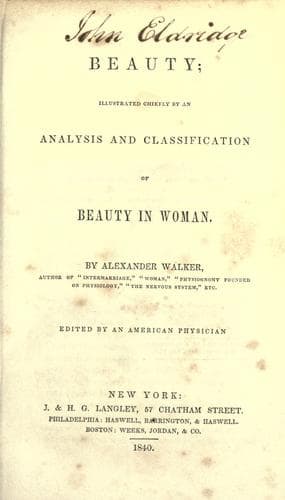
Beauty: Illustrated Chiefly by an Analysis and Classification of Beauty in WomanWalker, Alexander
Philosophy
Beauty: Illustrated Chiefly by an Analysis and Classification of Beauty in Woman
Walker, Alexander
Beauty, Personal; Women
"There is in all men a sufficient remembrance of the original natural
causes of pleasure, to enable them to bring all things offered to their
senses to that standard, and to regulate their feelings and opinions by
it.
"Suppose one who had so vitiated his palate as to take more pleasure in
the taste of opium than in that of butter or honey, to be presented with a
bolus of squills; there is hardly any doubt but that he would prefer the
butter or honey to this nauseous morsel, or to any other bitter drug to
which he had not been accustomed; which proves that his palate was
naturally like that of other men in all things, that it is still like the
palate of other men in many things, and only vitiated in some particular
points."
In the same manner, Payne Knight observes that "things, naturally the most
nauseous, become most grateful; and things, naturally most grateful, most
insipid.
"This extreme effect, however, only takes place where the palate has
become morbid and vitiated by continued, and even forced gratification;
and even when the metaphors taken from this sense, and employed to express
intellectual qualities, show that it is always felt and considered as a
corruption, even by those who are most corrupted: for though there are
many who prefer port wine to malmsey, and tobacco to sugar, yet no one
ever spoke of a sour or bitter temper as pleasant, or of a sweet one as
unpleasant." By this concession, Knight answers several of his own
objections.
"When it is said," farther observes Burke, very properly, "taste cannot be
disputed, it can only mean, that no one can strictly answer what pleasure
or pain some particular man may find from the taste of some particular
thing. This indeed cannot be disputed; but we may dispute, and with
sufficient clearness too, concerning the things which are naturally
pleasing or disagreeable to the sense. But when we talk of any peculiar or
acquired relish, then we must know the habits, the prejudices, or the
distempers of this particular man, and we must draw our conclusions from
those."
Hume proceeds to a second point, by observing that "one obvious cause, why
many feel not the proper sentiment of beauty, is the want of that
_delicacy_ of imagination which is requisite to convey a sensibility of
those finer emotions.
"Where the organs are so fine, as to allow nothing to escape them, and at
the same time so exact, as to perceive every ingredient in the
composition; this we call delicacy of taste, whether we employ these terms
in the literal or metaphorical sense."
Burke enlarges on this, after preliminary observing that "the power of the
imagination is incapable of producing anything absolutely new; it can only
vary the disposition of those ideas which it has received from the
senses. Now, the imagination is the most extensive province of pleasure
and pain, as it is the region of our fears and our hopes, and of all our
passions that are connected with them.
Public-domain text, read in full here on John Shaqi.
Reviews
Reviews
No reviews yet
Be the first to share your thoughts on this work.
Join the Discussion
Join the discussion
Sign in to leave a comment or review.
Sign InorCreate an account