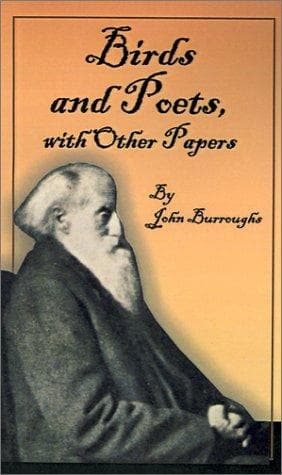
Birds and Poets : with Other PapersBurroughs, John
History
Birds and Poets : with Other Papers
Burroughs, John
American essays -- 19th century; Birds; Natural history -- Outdoor books; Nature
Numerous others of our birds would seem to challenge attention by their
calls and notes. There is the Maryland yellowthroat, for instance,
standing in the door of his bushy tent, and calling out as you approach,
_"which way, sir! which way, sir!"_ If he says this to the ear of common
folk, what would he not say to the poet? One of the peewees says _"stay
there!"_ with great emphasis. The cardinal grosbeak calls out _"what
cheer" "what cheer;"_ " the bluebird says _"purity," "purity," "purity;"_
the brown thrasher, or ferruginous thrush, according to Thoreau, calls
out to the farmer planting his corn, _"drop it," "drop it," "cover it
up," "cover it up"_ The yellow-breasted chat says _"who," "who"_ and
_"tea-boy"_ What the robin says, caroling that simple strain from
the top of the tall maple, or the crow with his hardy haw-haw, or the
pedestrain meadowlark sounding his piercing and long-drawn note in the
spring meadows, the poets ought to be able to tell us. I only know the
birds all have a language which is very expressive, and which is easily
translatable into the human tongue.
II TOUCHES OF NATURE
I
WHEREVER Nature has commissioned one creature to prey upon another, she
has preserved the balance by forewarning that other creature of what she
has done. Nature says to the cat, "Catch the mouse," and she equips her
for that purpose; but on the selfsame day she says to the mouse, "Be
wary,--the cat is watching for you." Nature takes care that none of her
creatures have smooth sailing, the whole voyage at least. Why has she
not made the mosquito noiseless and its bite itchless? Simply because
in that case the odds would be too greatly in its favor. She has taken
especial pains to enable the owl to fly softly and silently, because the
creatures it preys upon are small and wary, and never venture far from
their holes. She has not shown the same caution in the case of the crow,
because the crow feeds on dead flesh, or on grubs and beetles, or fruit
and grain, that do not need to be approached stealthily. The big fish
love to cat up the little fish, and the little fish know it, and, on the
very day they are hatched, seek shallow water, and put little sandbars
between themselves and their too loving parents.
How easily a bird's tail, or that of any fowl, or in fact any part of
the plumage, comes out when the hold of its would-be capturer is upon
this alone; and how hard it yields in the dead bird! No doubt there is
relaxation in the former case. Nature says to the pursuer, "Hold on,"
and to the pursued, "Let your tail go." What is the tortuous, zigzag
course of those slow-flying moths for but to make it difficult for the
birds to snap them up? The skunk is a slow, witless creature, and the
fox and lynx love its meat; yet it carries a bloodless weapon that
neither likes to face.
Public-domain text, read in full here on John Shaqi.
Reviews
Reviews
No reviews yet
Be the first to share your thoughts on this work.
Join the Discussion
Join the discussion
Sign in to leave a comment or review.
Sign InorCreate an account