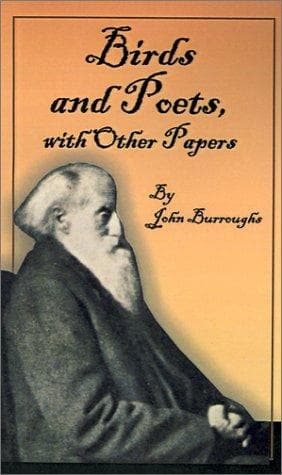
Birds and Poets : with Other PapersBurroughs, John
History
Birds and Poets : with Other Papers
Burroughs, John
American essays -- 19th century; Birds; Natural history -- Outdoor books; Nature
I recently heard of an ingenious method a certain other simple and
slow-going creature has of baffling its enemy. A friend of mine was
walking in the fields when he saw a commotion in the grass a few
yards off. Approaching the spot, he found a snake--the common garter
snake--trying to swallow a lizard. And how do you suppose the lizard was
defeating the benevolent designs of the snake? By simply taking hold
of its own tail and making itself into a hoop. The snake went round and
round, and could find neither beginning nor end. Who was the old giant
that found himself wrestling with Time? This little snake had a tougher
customer the other day in the bit of eternity it was trying to swallow.
The snake itself has not the same wit, because I lately saw a black
snake in the woods trying to swallow the garter snake, and he had made
some headway, though the little snake was fighting every inch of the
ground, hooking his tail about sticks and bushes, and pulling back with
all his might, apparently not liking the look of things down there
at all. I thought it well to let him have a good taste of his own
doctrines, when I put my foot down against further proceedings.
This arming of one creature against another is often cited as an
evidence of the wisdom of Nature, but it is rather an evidence of her
impartiality. She does not care a fig more for one creature than for
another, and is equally on the side of both, or perhaps it would be
better to say she does not care a fig for either. Every creature must
take its chances, and man is no exception. We can ride if we know
how and are going her way, or we can be run over if we fall or make a
mistake. Nature does not care whether the hunter slay the beast or the
beast the hunter; she will make good compost of them both, and her ends
are prospered whichever succeeds.
"If the red slayer think he slays,
Or if the slain think he is slain,
They know not well the subtle ways
I keep, and pass, and turn again."
What is the end of Nature? Where is the end of a sphere? The sphere
balances at any and every point. So everything in Nature is at the top,
and yet no _one_ thing is at the top.
She works with reference to no measure of time, no limit of space, and
with an abundance of material, not expressed by exhaustless. Did you
think Niagara a great exhibition of power? What is that, then, that
withdraws noiseless and invisible in the ground about, and of which
Niagara is but the lifting of the finger?
Public-domain text, read in full here on John Shaqi.
Reviews
Reviews
No reviews yet
Be the first to share your thoughts on this work.
Join the Discussion
Join the discussion
Sign in to leave a comment or review.
Sign InorCreate an account