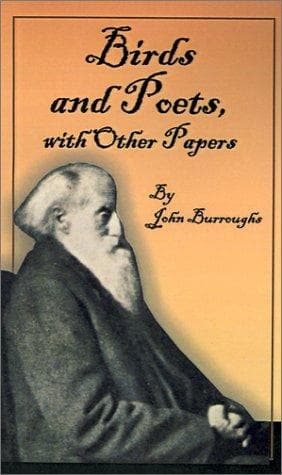
Birds and Poets : with Other PapersBurroughs, John
History
Birds and Poets : with Other Papers
Burroughs, John
American essays -- 19th century; Birds; Natural history -- Outdoor books; Nature
If heat were visible, or if we should represent it say by smoke, then
the December landscape would present a curious spectacle. We should see
the smoke lying low over the meadows, thickest in the hollows and moist
places, and where the turf is oldest and densest. It would cling to the
fences and ravines. Under every evergreen tree we should see the vapor
rising and filling the branches, while the woods of pine and hemlock
would be blue with it long after it had disappeared from the open
country. It would rise from the tops of the trees, and be carried this
way and that with the wind. The valleys of the great rivers, like the
Hudson, would overflow with it. Large bodies of water become regular
magazines in which heat is stored during the summer, and they give it
out again during the fall and early winter. The early frosts keep well
back from the Hudson, skulking behind the ridges, and hardly come over
in sight at any point. But they grow bold as the season advances, till
the river's fires, too, I are put out and Winter covers it with his
snows.
XI
One of the strong and original strokes of Nature was when she made the
loon. It is always refreshing to contemplate a creature so positive and
characteristic. He is the great diver and flyer under water. The loon
is the genius loci of the wild northern lakes, as solitary as they are.
Some birds represent the majesty of nature, like the eagles; others its
ferocity, like the hawks; others its cunning, like the crow; others
its sweetness and melody, like the song-birds. The loon represents
its wildness and solitariness. It is cousin to the beaver. It has the
feathers of a bird and the fur of an animal, and the heart of both. It
is as quick and cunning as it is bold and resolute. It dives with such
marvelous quickness that the shot of the gunner get there just in time
"to cut across a circle of descending tail feathers and a couple of
little jets of water flung upward by the web feet of the loon." When
disabled so that it can neither dive nor fly, it is said to face its
foe, look him in the face with its clear, piercing eye, and fight
resolutely till death. The gunners say there is something in its
wailing, piteous cry, when dying, almost human in its agony. The loon
is, in the strictest sense, an aquatic fowl. It can barely walk upon the
land, and one species at least cannot take flight from the shore. But in
the water its feet are more than feet, and its wings more than wings. It
plunges into this denser air and flies with incredible speed. Its head
and beak form a sharp point to its tapering neck. Its wings are far in
front and its legs equally far in the rear, and its course through the
crystal depths is like the speed of an arrow. In the northern lakes it
has been taken forty feet under water upon hooks baited for the great
lake trout. I had never seen one till last fall, when one appeared on
the river in front of my house. I knew instantly it was the loon. Who
Public-domain text, read in full here on John Shaqi.
Reviews
Reviews
No reviews yet
Be the first to share your thoughts on this work.
Join the Discussion
Join the discussion
Sign in to leave a comment or review.
Sign InorCreate an account