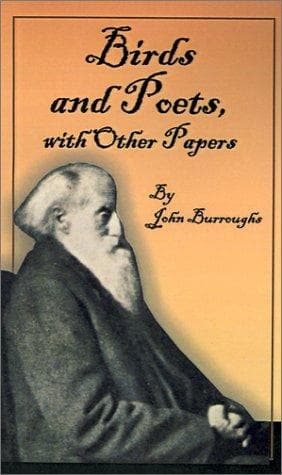
Birds and Poets : with Other PapersBurroughs, John
History
Birds and Poets : with Other Papers
Burroughs, John
American essays -- 19th century; Birds; Natural history -- Outdoor books; Nature
could not tell a loon a half mile or more away, though he had never seen
one before? The river was like glass, and every movement of the bird as
it sported about broke the surface into ripples, that revealed it far
and wide. Presently a boat shot out from shore, and went ripping up
the surface toward the loon. The creature at once seemed to divine the
intentions of the boatman, and sidled off obliquely, keeping a sharp
lookout as if to make sure it was pursued. A steamer came down and
passed between them, and when the way was again clear, the loon was
still swimming on the surface. Presently it disappeared under the
water, and the boatman pulled sharp and hard. In a few moments the bird
reappeared some rods farther on, as if to make an observation. Seeing it
was being pursued, and no mistake, it dived quickly, and, when it came
up again, had gone many times as far as the boat had in the same space
of time. Then it dived again, and distanced its pursuer so easily that
he gave over the chase and rested upon his oars. But the bird made a
final plunge, and, when it emerged upon the surface again, it was over
a mile away. Its course must have been, and doubtless was, an actual
flight under water, and half as fast as the crow flies in the air.
The loon would have delighted the old poets. Its wild, demoniac laughter
awakens the echoes on the solitary lakes, and its ferity and hardiness
are kindred to those robust spirits.
XII
One notable difference between man and the four-footed animals which
has often occurred to me is in the eye, and the greater perfection, or
rather supremacy, of the sense of sight in the human species. All
the animals--the dog, the fox, the wolf, the deer, the cow, the
horse--depend mainly upon the senses of hearing and smell. Almost their
entire powers of discrimination are confined to these two senses. The
dog picks his master out of the crowd by smell, and the cow her calf out
of the herd. Sight is only partial recognition. The question can only
be settled beyond all doubt by the aid of the nose. The fox, alert and
cunning as he is, will pass within a few yards of the hunter and not
know him from a stump. A squirrel will run across your lap, and a marmot
between your feet, if you are motionless. When a herd of cattle see a
strange object, they are not satisfied till each one has sniffed it; and
the horse is cured of his fright at the robe, or the meal-bag, or other
object, as soon as he can be induced to smell it. There is a great deal
of speculation in the eye of an animal, but very little science. Then
you cannot catch an animal's eye; he looks at you, but not into your
eye. The dog directs his gaze toward your face, but, for aught you can
tell, it centres upon your mouth or nose. The same with your horse or
cow. Their eye is vague and indefinite.
Public-domain text, read in full here on John Shaqi.
Reviews
Reviews
No reviews yet
Be the first to share your thoughts on this work.
Join the Discussion
Join the discussion
Sign in to leave a comment or review.
Sign InorCreate an account