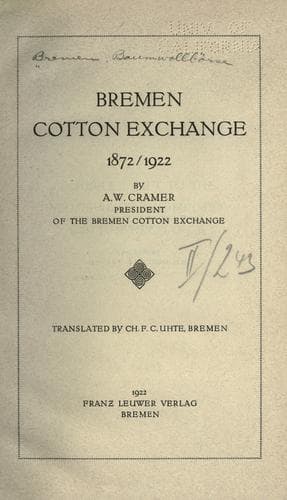
Bremen Cotton Exchange, 1872/1922Cramer, Andreas Wilhelm
History
Bremen Cotton Exchange, 1872/1922
Cramer, Andreas Wilhelm
Bremen (Germany). Baumwollbörse; Cotton trade
Cotton is sold to a large extent for distant delivery, but "future"
transactions are only those which are concluded on a specified "future"
exchange, under the rules and regulations of that particular exchange.
Here be it mentioned, that the Bremen Cotton Exchange is no exchange
within the meaning of the law. It has no regular hours of attendance,
nor has it special rules regulating the business in "futures". The
important "future" exchanges are Liverpool and New-York, and in a
lesser degree, Havre, Alexandria and New Orleans. Within the specified
hours of the "future" markets, large quantities of cotton contracts
change hands. There, buyers and sellers are constantly in attendance,
and it requires only a nod of the head to conclude a contract for
thousands of bales. The Rules, referring to "futures", do not differ
essentially from those governing the general trade, for it must be
borne in mind, that all "future" contracts demand the delivery of
actual cotton. Nobody can escape this duty, if he has sold futures, he
must deliver, unless he buys the contract back before it falls due, or
vice versa, which, of course, refers also to any ordinary delivery
contract. In fact, all transactions for delivery are settled either by
previous transfer or by fulfilment. It is noticeable how the stocks in
New-York increase or decline, in accordance with the tenders, against
"futures". No doubt, the great majority of the dealers intend to close
their contracts before they fall due, and the opportunity to do this,
presents itself every minute. In this, the "future" markets offer a
great advantage, or, if you like, a great temptation. In former days,
the dealing in "futures" had no legal protection in Germany, and
nowadays only under certain assumptions. Dealing in futures came within
the gaming act, and claims arising therefrom, were not actionable. The
Bremen Cotton Exchange has never accepted this view, but has constantly
fought against it, for very good reasons. The following explanation
will make it clear, that, as far as cotton is concerned, the trading in
futures is of great economic importance, and not practised for
snatching easily earned profits.
HEDGES.
A great market has the duty to adapt itself to all the requirements of
the Trade, and these are ever changing. For instance, new districts are
opened for commercial enterprise, new methods of doing business
develop, bringing increased activity in their train, and all this, has
to be regulated or arranged for.
Many things did not bother us in the past, as the following few
questions will show:
How can we, without risk of the market, sell cotton in Spring,
which will only be grown in Autumn?
How can a planter sell the cotton which he has picked, when there
are no buyers at the moment?
How can a manufacturer protect himself against a decline in the
price of cotton, while his goods are being prepared for the market?
Public-domain text, read in full here on John Shaqi.
Reviews
Reviews
No reviews yet
Be the first to share your thoughts on this work.
Join the Discussion
Join the discussion
Sign in to leave a comment or review.
Sign InorCreate an account