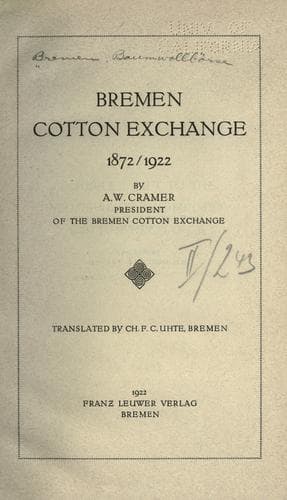
Bremen Cotton Exchange, 1872/1922Cramer, Andreas Wilhelm
History
Bremen Cotton Exchange, 1872/1922
Cramer, Andreas Wilhelm
Bremen (Germany). Baumwollbörse; Cotton trade
How can a manufacturer accept orders for late deliveries, without
possessing the cotton?
How can an importer take advantage of the great quantity of offers,
which flood the market, during the first few months of the
gathering of the crop?
To anybody in the cotton trade, these questions present no difficulties,
but, for the outside world, be it mentioned, that it is the "future"
market that furnishes the means to overcome these apparent anomalies.
It is the "future" contract, which eliminates the risk of the market
from the carefully managed cotton business.
Anybody who sells new crop cotton, buys a "future" contract as
provisional cover, it is then immaterial to him, whether the market
advances or declines. His actual sale price is the stipulated price,
and the differences which arise from the "future" contract, are added
or deducted. A planter, who cannot sell his cotton for the moment,
sells the equivalent amount of "futures". A bank takes charge of the
cotton and the "future" contract, and pays the price of the day. When
the cotton is finally sold, the bank is reimbursed by receiving the
then existing price of the day: plus or minus the differences on the
"future" contract.
A spinner finds himself, now and then, in the position that he cannot
effect sales against his production. With a decline in prices, mostly,
the cessation of the demand coincides. By selling a "future" contract,
he can safeguard himself. When the demand is brisk, a spinner may find
himself obliged to book orders, although the time for buying the raw
material is not propitious. Here also, the "futures" give the necessary
assistance.
The receipts of cotton are naturally biggest in the first few months of
the new season. Should an importer miss this opportunity of acquiring
most desirable cotton? No, he can buy, with impunity, as much cotton as
he considers advisable, for against each purchase, he can put out a
provisional sale of "futures". In the cotton trade therefore, two
transactions are frequently coupled. The main transaction, is the
trading in the actual article, while the accompanying "futures", are a
safety measure against the fluctuations of the market. This combination
of actual cotton and "futures", is called a "Hedge"--the origin of this
name is obscure. The "hedge" is a peculiarity of the cotton trade, it
may even be called, its life condition. The supreme Court of Law has,
in many decisions, upheld this condition. The endeavours of the cotton
trade have always been directed towards the minimising of the market
risk, and for this reason, "futures" have always played an important
part in cotton business.
Public-domain text, read in full here on John Shaqi.
Reviews
Reviews
No reviews yet
Be the first to share your thoughts on this work.
Join the Discussion
Join the discussion
Sign in to leave a comment or review.
Sign InorCreate an account