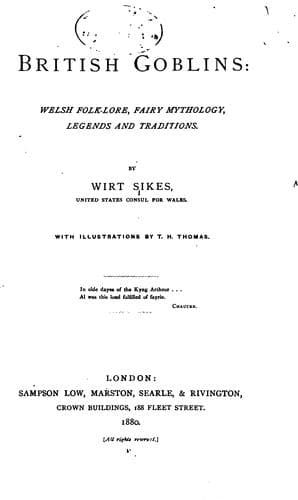
British Goblins: Welsh Folk-lore, Fairy Mythology, Legends and TraditionsSikes, Wirt
History
British Goblins: Welsh Folk-lore, Fairy Mythology, Legends and Traditions
Sikes, Wirt
Folklore -- Wales; Goblins -- Wales; Mythology, Celtic -- Wales; Mythology, Welsh; Wales -- Social life and customs
In all later days, other authors have written the same sort of thing;
it is not thus now, say they, but it was recently thus. The truth,
probably, is that if you will but sink down to the level of common
life, of ignorant life, especially in rural neighbourhoods, there you
will find the same old beliefs prevailing, in about the same degree to
which they have ever prevailed, within the past five hundred years. To
sink to this level successfully, one must become a living unit in that
life, as I have done in Wales and elsewhere, from time to time. Then
one will hear the truth from, or at least the true sentiments of, the
class he seeks to know. The practice of every generation in thus
relegating fairy belief to a date just previous to its own does not
apply, however, to superstitious beliefs in general; for, concerning
many such beliefs, their greater or less prevalence at certain dates
(as in the history of witchcraft) is matter of well-ascertained fact.
I confine the argument, for the present, strictly to the domain of
faerie. In this domain, the prevalent belief in Wales may be said to
rest with the ignorant, to be strongest in rural and mining
districts, to be childlike and poetic, and to relate to anywhere
except the spot where the speaker dwells--as to the next parish, to
the next county, to the distant mountains, or to the shadow-land of
Gwerddonau Llion, the green meadows of the sea.
FOOTNOTES:
[2] 'Archæologia Cambrensis,' 4th Se., vi., 174.
[3] 'Wyf of Bathes Tale,' 'Canterbury Tales.'
III.
In Arthur's day and before that, the people of South Wales regarded
North Wales as pre-eminently the land of faerie. In the popular
imagination, that distant country was the chosen abode of giants,
monsters, magicians, and all the creatures of enchantment. Out of it
came the fairies, on their visits to the sunny land of the south. The
chief philosopher of that enchanted region was a giant who sat on a
mountain peak and watched the stars. It had a wizard monarch called
Gwydion, who possessed the power of changing himself into the
strangest possible forms. The peasant who dwelt on the shores of Dyfed
(Demetia) saw in the distance, beyond the blue waves of the ocean,
shadowy mountain summits piercing the clouds, and guarding this mystic
region in solemn majesty. Thence rolled down upon him the storm-clouds
from the home of the tempest; thence streamed up the winter sky the
flaming banners of the Northern lights; thence rose through the
illimitable darkness on high, the star-strewn pathway of the fairy
king. These details are current in the Mabinogion, those brilliant
stories of Welsh enchantment, so gracefully done into English by Lady
Charlotte Guest,[4] and it is believed that all the Mabinogion in
which these details were found were written in Dyfed. This was the
region on the west, now covered by Pembroke, Carmarthen, and Cardigan
shires.
Public-domain text, read in full here on John Shaqi.
Reviews
Reviews
No reviews yet
Be the first to share your thoughts on this work.
Join the Discussion
Join the discussion
Sign in to leave a comment or review.
Sign InorCreate an account