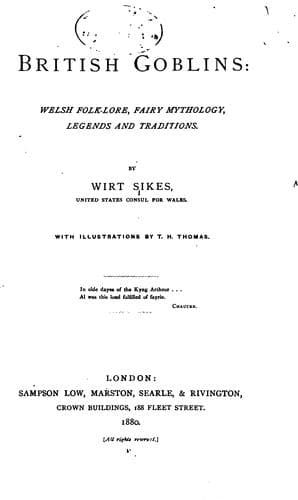
British Goblins: Welsh Folk-lore, Fairy Mythology, Legends and TraditionsSikes, Wirt
History
British Goblins: Welsh Folk-lore, Fairy Mythology, Legends and Traditions
Sikes, Wirt
Folklore -- Wales; Goblins -- Wales; Mythology, Celtic -- Wales; Mythology, Welsh; Wales -- Social life and customs
More recently than the time above indicated, special traditions have
located fairyland in the Vale of Neath, in Glamorganshire. Especially
does a certain steep and rugged crag there, called Craig y Ddinas,
bear a distinctly awful reputation as a stronghold of the fairy
tribe.[5] Its caves and crevices have been their favourite haunt for
many centuries, and upon this rock was held the court of the last
fairies who have ever appeared in Wales. Needless to say there are men
still living who remember the visits of the fairies to Craig y Ddinas,
although they aver the little folk are no longer seen there. It is a
common remark that the Methodists drove them away; indeed, there are
numberless stories which show the fairies to have been animated, when
they were still numerous in Wales, by a cordial antipathy for all
dissenting preachers. In this antipathy, it may be here observed,
teetotallers were included.
FOOTNOTES:
[4] 'The Mabinogion, from the Welsh of the Llyfr Coch o Hergest.'
Translated, with notes, by Lady Charlotte Guest. (New Edition, London,
1877.)
[5] There are two hills in Glamorganshire called by this name, and
others elsewhere in Wales.
IV.
The sovereign of the fairies, and their especial guardian and
protector, was one Gwyn ap Nudd. He was also ruler over the goblin
tribe in general. His name often occurs in ancient Welsh poetry. An
old bard of the fourteenth century, who, led away by the fairies, rode
into a turf bog on a mountain one dark night, called it the 'fish-pond
of Gwyn ap Nudd, a palace for goblins and their tribe.' The
association of this legendary character with the goblin fame of the
Vale of Neath will appear, when it is mentioned that Nudd in Welsh is
pronounced simply Neath, and not otherwise. As for the fairy queen,
she does not seem to have any existence among Cambrian goblins. It is
nevertheless thought by Cambrian etymologists, that Morgana is derived
from Mor Gwyn, the white maid; and the Welsh proper name Morgan can
hardly fail to be mentioned in this connection, though it is not
necessarily significant.
Public-domain text, read in full here on John Shaqi.
Reviews
Reviews
No reviews yet
Be the first to share your thoughts on this work.
Join the Discussion
Join the discussion
Sign in to leave a comment or review.
Sign InorCreate an account