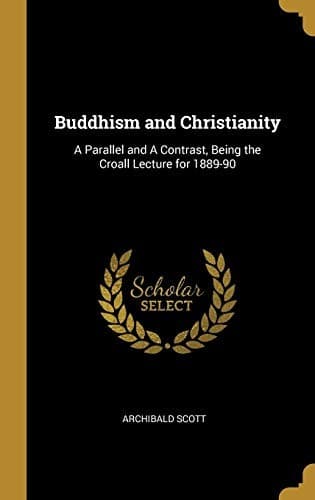
Buddhism and Christianity: A Parallel and a ContrastScott, Archibald
Religion
Buddhism and Christianity: A Parallel and a Contrast
Scott, Archibald
Buddhism -- Relations -- Christianity; Christianity and other religions -- Buddhism
For our knowledge of Buddhism, therefore, we have for centuries only
oral traditions to rely upon. Of these traditions only a portion may be
traced approximately to the times of Buddha, and of the fragments which
can possibly be traced not one contains a narrative nor any historical
reference to passing events. On the contrary, our knowledge of the
origin of Christianity is derived not from fragments of oral tradition,
but from a set of canonical writings, many of them traceable close to
the generation that witnessed Christ’s death, in which the story of His
ministry is set in historical relation to the age in which He appeared,
and His peculiar doctrines are so fixed that any addition to them is at
once recognised as spurious. Between the extremes of criticism as to the
period covered by the life of Christ there is a difference of only half
a dozen years; but there is a difference in Buddhist traditions of more
than a thousand years as to the date of Buddha’s birth, and even
European scholars, after carefully sifting traditions and writings, have
only been able approximately to fix dates for his death ranging over a
period of 175 years.[73]
For historical accuracy, therefore, the traditions are as worthless as
they are for any photographic presentation of the various persons who
figure in them. In truth we have in them neither chronology nor
biography. Events and actors are equally indistinct; we have only a
background without any perspective, and pasteboard puppets projected
against it which might be designated by any name whatever. Even in
respect of transmission of doctrine, oral tradition was found very early
to have failed. The reason given in their chronicles for resorting to
writing is confession sufficient that they considered that method of
preserving the deposit of the faith a safer one.[74] So divergent had
the renderings and so corrupt had the texts become—“for even the monks
of the great council were blamed for turning the religion upside down,
for distorting the sense and teaching of the five Nikayas, for casting
aside that Sutta and Vinaya, and making imitations of them changing this
to that[75]—that the profoundly wise priests, foreseeing the perdition
of the people (from the perversion of the doctrines), and in order that
the religion might endure for ages, wrote the same in books.”[76] Before
this time the many schisms which had arisen were powerful illustrations
of the evils which the “profoundly wise” transcribers deplored, and of
that falling away from the original creed which this religion had
already suffered for lack of a secured basis of faith.[77]
Public-domain text, read in full here on John Shaqi.
Reviews
Reviews
No reviews yet
Be the first to share your thoughts on this work.
Join the Discussion
Join the discussion
Sign in to leave a comment or review.
Sign InorCreate an account