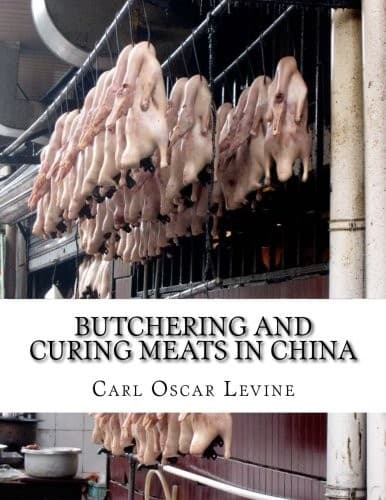
Butchering and curing meats in ChinaLevine, Carl Oscar
Science
Butchering and curing meats in China
Levine, Carl Oscar
Meat -- Preservation; Slaughtering and slaughter-houses -- China
Because of careless selection of breeding stock, most of the hogs in
the region of Canton have low backs, large bellies, scant hams, never
produce the best quality of meat, and have a low dressing percentage.
The improved hog with a level or slightly arched wide back, long,
deep, smooth sides, full hams, and short neck and head, has meat of
the best quality, and such hogs have the highest dressing percentage.
Fine bone, soft hair, and mellow flesh, qualities generally found in
well bred animals, are desired in all animals used for meat, as they
indicate meat of a good quality, with a minimum of waste.
§ 9. Feeding
The kind of food the hog gets during the last six or eight weeks of
the fattening period largely determines the flavor and the character
of the meat. During that period, it is best not to feed very much of
rice bran, or peanut cake, as when such feeds are given they produce
very soft, oily fat. Wheat bran and corn produce a firm fat, and one
or the other, or both together, should constitute a large part of the
grain ration for the fattening hog.
§ 10. Age and Size for Killing
It is a well known fact that meat from an old animal is very likely to
be tough and difficult to cook sufficiently to make it tender. On the
other hand, meat from very young animals is watery and often lacks
flavor. An old animal in good condition is to be preferred to a young
one in poor condition. Hogs can be killed for meat any time after six
weeks, but the most profitable age at which to slaughter is from eight
to ten months. Hogs at that age have a higher dressing percentage than
when younger. Gain in weight is made at a lower cost in young animals
than in older animals. For this reason, it is not advisable to keep a
hog much longer than twelve months, or a beef animal more than two
years, unless feed is very cheap.
If the pork is to be cured, the hogs for butchering should weigh from
one hundred and thirty to two hundred pounds. Larger hogs can be
butchered conveniently, although a hog much heavier will be more
difficult to handle.
In southern China, where the day temperature is seldom below sixty
degrees Fahrenheit during the butchering season, a difficulty in
cooling the meat will be experienced, unless ice is used, and if the
meat is not properly cooled it will not cure well.
Chickens have the most tender meat at the age of three to six months,
depending on the variety, and at that age sell for the highest price.
Poultry that have just reached maturity are best for curing.
Preparation of the Animals for Slaughter
Public-domain text, read in full here on John Shaqi.
Reviews
Reviews
No reviews yet
Be the first to share your thoughts on this work.
Join the Discussion
Join the discussion
Sign in to leave a comment or review.
Sign InorCreate an account