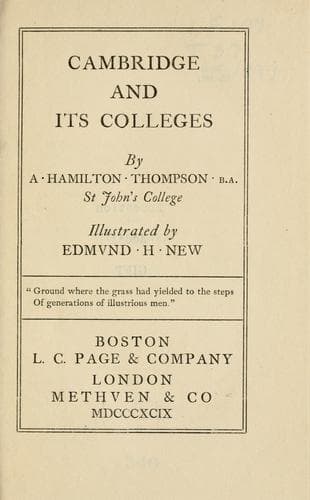
Cambridge and Its CollegesThompson, A. Hamilton (Alexander Hamilton)
History
Cambridge and Its Colleges
Thompson, A. Hamilton (Alexander Hamilton)
University of Cambridge
To the society of Peterhouse, for some years of Perne’s time, belonged
the celebrated John Whitgift. Whitgift was an example of a system which
has now ceased to a great extent in Cambridge. He was an undergraduate
of Queens’ to begin with; he then obtained a fellowship at Peterhouse,
and was in succession Master of Pembroke and Trinity before his elevation
to a bishoprick. His connection with Peterhouse is very passing, but,
while a member of the college, he held the Lady Margaret Professorship of
Divinity. In 1567, when he became Master of Pembroke, he vacated it for
the Regius Professorship, which he held until his translation to the See
of Worcester. At the same time Peterhouse held also another professor, Dr
Thomas Lorkin, who occupied the Regius Chair of Physic. Professorships
were then commonly held with other offices, and John Richardson, fellow
of Emmanuel, who was Master of Peterhouse from 1609 to 1615 was also
Regius Professor of Divinity.
Richardson became Master of Trinity in 1615. In the time of his
successor, Thomas Turner, one of Peterhouse’s most celebrated sons was
in residence, the poet Richard Crashaw. The beginning of the sixteenth
century found many poets at Cambridge, of whom Crashaw is certainly not
the least remarkable. Like George Herbert, who was some twenty years his
senior, he was brought up in the traditions of the Church of England,
but scarcely had time to prove his principles before the outbreak of the
Civil War. He was by temperament a mystic, and his early love-poems show
a certain religious tendency. It is probable that his study of St Theresa
and the bigotry of the Puritan party drove him, between them, into the
Church of Rome. He eventually took orders and died as a Canon of Loreto.
His mystical poems have become very fashionable of late years, and he
certainly deserves a very high place among our lyric poets. He was also a
musician. Although we know little of his life at Cambridge, it is certain
that he must have been a prominent figure in the intellectual life of a
period when University life was entirely intellectual.
Public-domain text, read in full here on John Shaqi.
Reviews
Reviews
No reviews yet
Be the first to share your thoughts on this work.
Join the Discussion
Join the discussion
Sign in to leave a comment or review.
Sign InorCreate an account