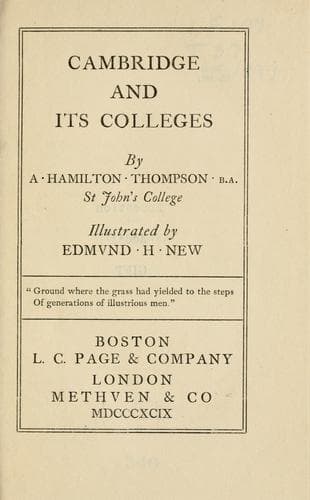
Cambridge and Its CollegesThompson, A. Hamilton (Alexander Hamilton)
History
Cambridge and Its Colleges
Thompson, A. Hamilton (Alexander Hamilton)
University of Cambridge
In 1632 the chapel was finished and was consecrated in the next year
by Bishop Francis White of Ely. Next year the master, Dr Matthew Wren,
was succeeded by Dr John Cosin. The new master was one of the most
acute theologians of the century, and was deeply impressed, like most
contemporary churchmen, with the possibilities of the Church of England.
He was one of the first to vindicate its position and maintain its orders
as valid. His proceedings at Peterhouse were hardly popular. Cambridge
has never been guilty of over-rating external forms of worship, and,
in the case of Cosin, she showed her indignation very plainly. The
Puritans were furious at his ritual; they complained of his bowings and
genuflexions, and of the crucifix he set up over the altar of his chapel.
In 1643 the iconoclast Dowsing paid a visit to Cambridge, and used the
most drastic remedies at Peterhouse. Fortunately, the beautiful east
window, which would have provoked his zealous wrath, was hidden by the
Society and escaped damage. Cosin was ejected by Parliament in 1644, and
for sixteen years the college was ruled by Lazarus Seaman. Cosin returned
at the Restoration, and the “idols” were restored to their proper place.
But in the same year Cosin was rewarded for his long exile with the See
of Durham. In the magnificent chapel which he built at Auckland Castle,
we may trace in some measure his affection to Peterhouse; for its
beautiful late Gothic was doubtless suggested by Dr Wren’s chapel.
Cosin has had no very conspicuous successors. He was the last Master
of Peterhouse but one who became a bishop. His immediate predecessors,
Leonard Maw and Matthew Wren, were both translated to bishopricks: Maw to
Bath and Wells, and Wren, whose name is most famous, to Ely. During the
time of Dr Law,* Bishop of Carlisle, who was master from 1754 to 1788,
and filled for a short time the chair of Moral Philosophy, the poet Gray
was obliged to change his residence to Pembroke. Gray is one of those
persons, uncommon in the last century, who saw beauty in nature, and he
became a kind of artistic apostle at Cambridge. This position, which
usually connotes a superiority amounting to superciliousness, did not
render him popular at Peterhouse. He had a horror of fire, and kept a
fire-escape attached to his window. One night, some of the more normal
members of the college raised an alarm of fire, and Gray descended
his fire-escape into a bucket of water which had been prepared for
him. Having all that lack of humour which is distinctive of æsthetic
reformers, he migrated to Pembroke, where he seems to have been better
appreciated than in his own college. He lived in Pembroke for the last
twenty-five years of his life, and, for the last three (1768-71), was
Regius Professor of Modern History.
Public-domain text, read in full here on John Shaqi.
Reviews
Reviews
No reviews yet
Be the first to share your thoughts on this work.
Join the Discussion
Join the discussion
Sign in to leave a comment or review.
Sign InorCreate an account