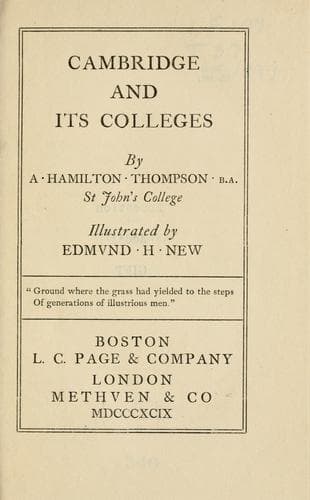
Cambridge and Its CollegesThompson, A. Hamilton (Alexander Hamilton)
History
Cambridge and Its Colleges
Thompson, A. Hamilton (Alexander Hamilton)
University of Cambridge
Dr Law died in 1788, and was succeeded by Dr Francis Barnes,* who
continued in his seat for fifty years, holding, like his predecessor, the
Professorship of Moral Philosophy from 1813 to his death in 1838. Then
Dr Hodgson was master for nine years, and his successor, Dr Cookson, was
succeeded in 1876 by the present Master. Among the notable men of the
present day Peterhouse claims the Archbishop of York and Lord Kelvin.*
Through Lord Kelvin’s generosity, it was the first college in Cambridge
to use electric light. None of the rest have adopted this modern
improvement till quite recently, and even now it is by no means general.
Peterhouse, however, has kept up its traditions and occupies a leading
place in the history of scientific progress: for, beside Lord Kelvin, its
books contain the names of the mathematician Dr Routh* and the well-known
Professor Dewar (* Orchardson).
IV
CLARE COLLEGE
[Illustration: Clare College]
Loggan, in his invaluable _Cantabrigia Illustrata_, gives us two views of
the court of Clare, the first a bird’s-eye view of the whole building,
the second an elevation of the north side, as it was completed at the
end of Queen Anne’s reign. The college had to pass through some trouble
before its buildings were completed. After its foundation in 1342, a
court was built which lasted till 1525. It was then injured by fire. The
remains were taken down, and preparations were made for a new building,
which was not begun till 1638, an unfortunate period. During the Civil
Wars, the work was at a standstill, and the north side, built principally
during the mastership of Dr Samuel Blythe (1678-1713), was not actually
finished till 1715. Sir George Downing, then a fellow commoner,
contributed to its completion. Later, in 1769, the present Chapel was
built from the designs of the Master of Caius, Sir James Burrough. Clare
thus presents examples of three distinct periods in Renaissance work. The
earliest portion is the eastern side of the court with the gateway, the
beauty of which cannot be too highly praised. The style is the fantastic
Italian Gothic of the period, mixed largely with classical forms; but the
work is free from what Mr Ruskin would call insincerity. It is useful to
compare it with the chapel at Peterhouse, consecrated five years before
this was begun. Its characteristics are those of all the cultured work
of the early Stewart period, and have points in common with a building
like Ingestre Hall near Stafford, which has unfortunately perished by
fire. The south side is of the same date; the admirable proportions of
this part of the court may be seen from the grounds of King’s. On the
western side is a building of the time of Charles II. and James II. Its
inner face harmonises fairly well with the rest, but debased forms,
such as the meaningless broken arch, appear. The river front is pure
Palladian, and the effect of the order of pilasters which runs through
the two upper stories is very harsh.
Public-domain text, read in full here on John Shaqi.
Reviews
Reviews
No reviews yet
Be the first to share your thoughts on this work.
Join the Discussion
Join the discussion
Sign in to leave a comment or review.
Sign InorCreate an account