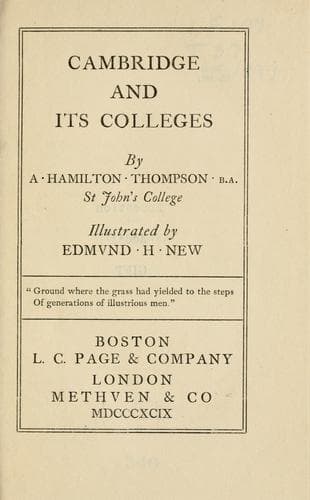
Cambridge and Its CollegesThompson, A. Hamilton (Alexander Hamilton)
History
Cambridge and Its Colleges
Thompson, A. Hamilton (Alexander Hamilton)
University of Cambridge
Matthew Parker, master from 1544 to 1553, was the great ornament of the
college at this period. He is more famous as Archbishop of Canterbury
than as a don, but Corpus holds his name in great honour. His great
collection of manuscripts is preserved in the Library. The bequest was
accompanied by one of those odd provisions by which benefactors ensured
the jealous care of their possessions after their death. If twenty-five
manuscripts are lost, the collection is to go to Caius; if Caius is
guilty of neglect, it passes to Trinity Hall. The provision is rigidly
attended to, and the inspection of the manuscripts is an affair of great
circumstance, for which the presence of the librarian, a fellow and a
scholar is necessary. Perhaps the most historical document in the Library
is the original draft of the Thirty-Nine Articles. Parker also left some
very valuable plate to the college, cups and apostle-spoons. There is a
portrait of him in the Hall, and another in the Master’s Lodge.
Corpus has a distinguished roll of Elizabethan worthies. Besides
Sir Nicholas Bacon and Parker, we find the names of two dramatists,
Christopher Marlowe, one of the greatest of all, and Giles Fletcher, the
collaborator of Beaumont. The father of the latter was also a member
of the college, and became Bishop, first of Bristol, then of London.
George Wishart, the Scottish martyr, was here at some time early in the
sixteenth century. In 1590 John Jegon* became master. Afterwards, as
Bishop of Norwich, Jegon was not a great success: as Master of Corpus his
strictness made him unpopular. There is a story that he fined some of the
scholars for a breach of rules, and applied the proceeds to the repair of
the college. One of the delinquents afterwards wrote on a wall of the
college this couplet,
Dr Jegon, Bene’t College Master,
Broke the scholars’ heads and gave the wall a plaster.
Beneath this elegant conceit Jegon wrote a distich of his own.
Knew I but the wag that wrote this verse in bravery,
I’d commend him for his wit, but whip him for his knavery.
Jegon was Vice-Chancellor from 1596 to 1601, and his arms appear on
the plaster ceiling of the old Senate House, now incorporated in the
University Library. His brother Thomas succeeded him at Corpus and was
also Vice-Chancellor in 1609. Both brothers died in 1618.
Public-domain text, read in full here on John Shaqi.
Reviews
Reviews
No reviews yet
Be the first to share your thoughts on this work.
Join the Discussion
Join the discussion
Sign in to leave a comment or review.
Sign InorCreate an account