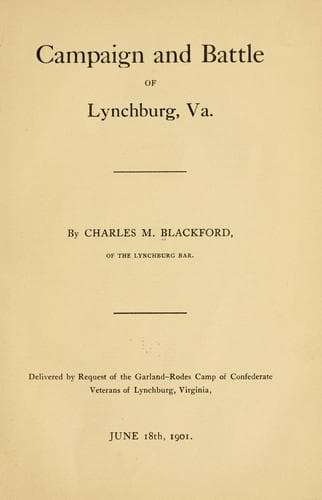
Campaign and battle of Lynchburg, Va. — John Shaqi
Campaign and battle of Lynchburg, Va.Blackford, Charles Minor
History
Campaign and battle of Lynchburg, Va.
Blackford, Charles Minor
Lynchburg (Va.) -- History -- Civil War, 1861-1865; Lynchburg, Battle of, Lynchburg, Va., 1864
These guns of Lieutenant Berkeley had done good service in the Valley
and rendered themselves and their young commander very famous. They
reached Lynchburg by forced marches, through the upper part of Amherst
County, on the evening of the 16th of June. On their arrival at the
bridge across James River, they were urged forward, as it was supposed
Hunter was even then in sight. The general direction in which the
enemy was expected was pointed out to Berkeley, who was ignorant of
Lynchburg and its topography. He was told to go directly out from the
bridge to the hills west of the city, so he urged his weary horses up
Ninth street, passed the old market house to the foot of Courthouse
hill. There even his nerve was daunted, and he turned up Church street
to Eighth. He halted a moment, wondering what sort of teams and
conveyances they had in Lynchburg, but noticing that Eighth street
was the nearest route to the enemy, he urged his horses up the steep
declivity, putting several men at each wheel. One-third of the hill was
thus surmounted, but there is a limit to human and equine endurance,
and the two guns and their caissons stalled hopelessly. Fortunately
some of Imboden's cavalry were just passing at the foot of the hill
on Church street. They saw the trouble, and knowing how important it
was to get those useful guns into action, jumped from their horses,
reinforced the storming party and soon had the guns at the top of the
hill; thence, at a gallop, they moved forward into the line of battle.
The line then selected extended from a point some distance to the
left of the turnpike through the toll-gate into what is now known
as Langhorne's field. The residue of Early's command did not reach
Lynchburg until late on the afternoon of the 18th, when it was hurried
through the city at a double quick, much to the relief of the citizens,
who cheered them on their pathway. During the night of the 17th a yard
engine, with box cars attached, was run up and down the Southside
Railroad, making as much noise as possible, and thus induced Hunter to
believe and to report that Early was rapidly being reinforced.
Senator John W. Daniel, then a Major on Early's staff, though at the
time disabled from duty by a very dangerous wound, describes the
entrance of these troops upon the scene as follows:
"In this condition Tinsley, the bugler of the Stonewall Brigade, came
trotting up the road sounding the advance, and behind him came the
skirmishers of Ramseur's Division with rapid strides. Just then the
artillerists saw through the smoke the broad white slouch hat of 'Old
Jube,' who rode amongst them....
Poor Tinsley! His last bugle call, like the bagpipes at Lucknow,
foretold the rescue of Lynchburg, but on that field he found, in a
soldier's duty and with a soldier's glory, a soldier's death."
Public-domain text, read in full here on John Shaqi.
Reviews
Reviews
No reviews yet
Be the first to share your thoughts on this work.
Join the Discussion
Join the discussion
Sign in to leave a comment or review.
Sign InorCreate an account