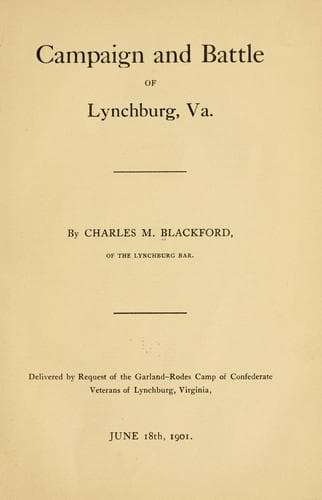
Campaign and battle of Lynchburg, Va. — John Shaqi
Campaign and battle of Lynchburg, Va.Blackford, Charles Minor
History
Campaign and battle of Lynchburg, Va.
Blackford, Charles Minor
Lynchburg (Va.) -- History -- Civil War, 1861-1865; Lynchburg, Battle of, Lynchburg, Va., 1864
Up to that time Hunter's army was several times larger than that
opposing him. The addition of Rodes' command and the residue of
Gordon's to the Confederate forces the next night diminished the
disparity, but made our army but little over one-half as large as that
under Hunter. Yet Hunter did not make any serious demonstration on the
17th, nor until after two o'clock on the 18th. There was firing along
the picket line and much cannonading, but no serious fight until that
hour.
Half of the Second Corps and Breckinridge's command, with some fifteen
guns, occupied the front line, while the cadets, the dismounted cavalry
and the invalid corps occupied the inner line established by Hill.
On the 18th General Duffie's division of the enemy made some attack on
Early's right. This attack by Duffie with his division of two brigades
of cavalry and a battery of artillery is described by him in a report
made in the field to General Hunter on June 18. He says:
"I have carried out your order in engaging the enemy on the extreme
left. I attacked him at 12:30 and drove him into his fortifications.
Have been fighting ever since. Two charges have been made and
the enemy's strength fully developed in our front. His force is
much superior to mine. All my force is engaged. The enemy is now
attempting to turn my right. I shall send a force to check him. I do
not communicate with Averell on my left." (70 W. of R. 650.)
This force which Duffie describes as so superior to his consisted
of two small brigades of infantry under General Gabe C. Wharton and
the cavalry under General John McCausland. It is impossible that the
whole force was half the size of Duffie's. Wharton's command was but
a remnant left from Gaines' Mill and Cold Harbor, and McCausland's
had been in one continuous fight for ten days, and was therefore
much dismounted, worn and weary. Of the two so-called brigades under
Wharton, one was commanded by our gallant comrade, Colonel Aug.
Forsberg, and had, under his leadership, been more than decimated in
the fights around Richmond during the four weeks immediately preceding.
Had Hunter made a vigorous assault on the line through Judge Daniel's
Rivermont farm, he could have marched directly into Lynchburg and
burned the railroad bridges without successful resistance, for Early
could not have spared a man from his line to oppose him. Wharton's two
brigades were both east of the Blackwater, and between that stream and
James River there was only the skirmish line of McCausland's cavalry,
and a few old men in the trenches across the Rivermont farm. These old
citizens, however, though entirely "muster free" either from age or
physical infirmity, did good service. They remained in the trenches,
though without equipment or even the scant comforts of the regular
soldier, and were anxiously and gallantly awaiting the anticipated
attack. Had it been made, they were ready to die in defence of their
homes.
Public-domain text, read in full here on John Shaqi.
Reviews
Reviews
No reviews yet
Be the first to share your thoughts on this work.
Join the Discussion
Join the discussion
Sign in to leave a comment or review.
Sign InorCreate an account