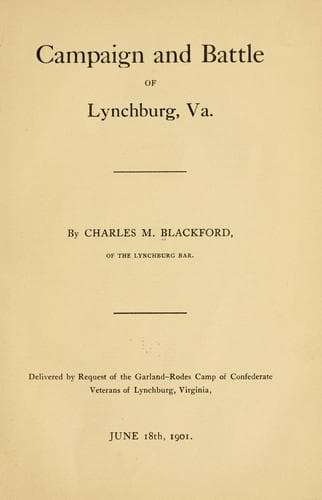
Campaign and battle of Lynchburg, Va.Blackford, Charles Minor
History
Campaign and battle of Lynchburg, Va.
Blackford, Charles Minor
Lynchburg (Va.) -- History -- Civil War, 1861-1865; Lynchburg, Battle of, Lynchburg, Va., 1864
Here the right gave way, and our brigade being exposed to a close
firing of musketry, grape and canister, we were obliged to retire
about thirty paces to a new line of battle, which was held _until
orders were received to fall back. Marched all that night_, and
reached Liberty about 3 p.m. on the 9th." (70 W. of R. 135.)
Colonel Rutherford B. Hayes, afterwards President of the United States,
in reporting the battle of the 18th, says:
"Pursued the retreating rebels and drove them from their rifle-pits to
the protection of their main works. The works being too strong to be
carried by the force then before them, the regiment _retired in some
disorder_, but was promptly reformed before reaching our own lines.
After leaving Lynchburg the officers and men of the First Brigade
sustained themselves through the hardships and privation of the
retreat like good soldiers." (70 W. of R. 123.)
Other quotations from other reports might be made to the same effect.
That these reports may have their true significance it is necessary
that we note what General Hunter himself says of what took place on the
17th and 18th. It will be found difficult to understand where all the
glory comes in. He writes:
"Early in the morning of the 17th orders were given for the troops
to move, but the march was delayed for several hours at the Great
Otter River, owing to the difficulty in crossing the artillery, and
in consequence we did not overtake the enemy until four o'clock in
the afternoon. At that hour Averell's advance came upon the enemy,
strongly posted and intrenched at Diamond Hill, five miles from
Lynchburg. He immediately attacked, and a sharp contest ensued.
Crook's infantry arriving at the same time, made a brilliant advance
upon the enemy, drove him from his works back upon the town, killing
and wounding a number and capturing seventy men and one gun. It being
too late to follow up this success, we encamped upon the battle-field.
The best information to be obtained at this point of the enemy's
forces and plans indicated that all the rebel forces heretofore
operating in the Valley and West Virginia were concentrated in
Lynchburg, under the command of General Breckinridge. This force was
variously estimated at from ten thousand to fifteen thousand men, well
supplied with artillery, and protected by strong works.
Public-domain text, read in full here on John Shaqi.
Reviews
Reviews
No reviews yet
Be the first to share your thoughts on this work.
Join the Discussion
Join the discussion
Sign in to leave a comment or review.
Sign InorCreate an account