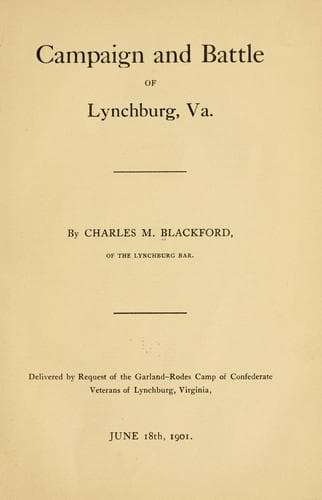
Campaign and battle of Lynchburg, Va.Blackford, Charles Minor
History
Campaign and battle of Lynchburg, Va.
Blackford, Charles Minor
Lynchburg (Va.) -- History -- Civil War, 1861-1865; Lynchburg, Battle of, Lynchburg, Va., 1864
In his memoirs (on page 44) General Early says that some time after
midnight it was discovered that Hunter was moving, but, owing to
the uncertainty as to whether he was merely changing front or
retreating, nothing could be done until daylight, when, the retreat
being ascertained, the pursuit commenced. Early's army moved in three
columns, the Second Corps on the Salem Turnpike, Breckinridge's
command, under Elzey, on the Forest Road, and the cavalry, placed by
Early under General Robert Ransom, on the right of Elzey. The enemy's
rear was overtaken at Liberty by Ramseur's division and was driven
through that place at a brisk trot.
It is not within the scope of this paper to follow up the retreat of
Hunter, nor to narrate the incidents of Early's campaign in Maryland
and the scare he gave the Government at Washington. What a commotion
his little army created can be easily understood by inspecting the 70th
and 71st volumes of the War of the Rebellion, a large part of which
is taken up by the numberless orders and counter-orders, alarms and
outcries incident to the fright then prevailing. General Grant seems
to have been the only person in command on the other side who kept his
equilibrium and acted with consistent courage and judicious poise.
But before we return to the scenes around Lynchburg incident to the
attack, it may well be noted that Hunter, after reaching Salem, turned
off to Lewisburg, West Virginia, and did not feel safe until he had
placed his army far beyond the Alleghanies and upon the banks of the
Ohio at Parkersburg. The effect of this remarkable line of retreat was
that the Valley was left open, and Early seized the opportunity and at
once commenced his march for the Potomac practically unmolested. On the
5th of July Hunter and his command were at Parkersburg, on the Ohio,
while Early, whom he was to obstruct, was crossing the Potomac River
into Maryland.
Poor Hunter! he seems to have had few friends, and it is almost
cruel to recite his history, but men who undertake great enterprises
must expect to be criticised when they fail. He got little comfort,
and expected none, from the Confederate leaders, but he got even
less from the Federal, except when it came in the form of such
reports as that sent by Captain T.K. McCann to General Meigs, the
Quartermaster-General, in which he says that "General Hunter fought
four hours on the 17th; on the 18th the General ascertained that Rebel
force at Lynchburg was fifty-thousand men, and from a prisoner taken
it was reported that Lee was evacuating Richmond and falling back on
Lynchburg, and consequently General Hunter was obliged to fall back."
(Id. 679.) General Grant, however, on the 21st of June, wrote General
Meade to know where Hunter was, and said, "Tell him _to save his army_
in the way he thinks best." (Id. 657.)
Public-domain text, read in full here on John Shaqi.
Reviews
Reviews
No reviews yet
Be the first to share your thoughts on this work.
Join the Discussion
Join the discussion
Sign in to leave a comment or review.
Sign InorCreate an account