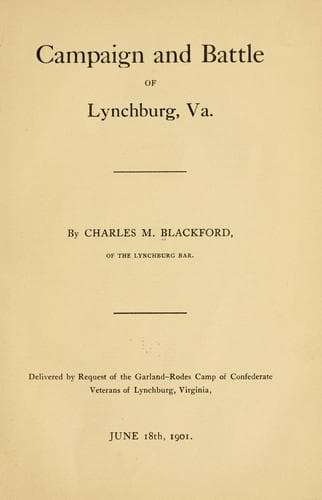
Campaign and battle of Lynchburg, Va.Blackford, Charles Minor
History
Campaign and battle of Lynchburg, Va.
Blackford, Charles Minor
Lynchburg (Va.) -- History -- Civil War, 1861-1865; Lynchburg, Battle of, Lynchburg, Va., 1864
On the 17th of July Halleck wrote to Hunter, giving him some directions
in regard to his future movements, saying that "General Grant directs,
if compelled to fall back, you will retreat _in front of the enemy_
towards the Potomac, so as to cover Washington _and not be squeezed
out to one side_, so as to make it necessary to fall back into
West Virginia to save your army." This order he disregarded most
ignominiously.
In the same letter Halleck wrote Hunter that General Grant said that in
the marching _he does not want houses burned_, but "that he wants your
troops to eat out Virginia clear and clean as far as they can, so that
crows flying over it for the balance of the year will have to carry
their rations with them." (Id. 366.)
C.A. Dana, Assistant Secretary of War, wrote to Grant on the 15th of
July (Id. 332): "Hunter appears to have been engaged in a pretty active
campaign _against the newspapers_ in West Virginia." And Halleck on the
same day wrote to Grant that he thought "_Hunter's command was badly
used up in the Lynchburg expedition_." (Id. 331.)
These assaults, and many others of a like nature, wounded General
Hunter so greatly that he not only asked to be relieved, but wrote a
letter to Grant, in which, after speaking of the depressing effect
upon him of these comments, he unstopped the vials of his wrath against
his subordinates, upon whom he put the blame of his defeat.
In this letter he says that Sullivan, who commanded one of his
divisions, was "_not worth one cent_; in fact very much in my way,"
and, again, he says: "I dashed on toward Lynchburg, and _should
certainly have taken it if it had not been for the stupidity and
conceit of that fellow Averell_, who unfortunately joined me at
Staunton, and of whom I unfortunately had, at the time, a very high
opinion, and trusted him when I should not have done so." (71 W. of R.
366.)
With these quotations from the correspondence of his associates,
General Hunter may be left to the verdict which will be accorded him by
the future historian of the stirring events in which he took part.
Public-domain text, read in full here on John Shaqi.
Reviews
Reviews
No reviews yet
Be the first to share your thoughts on this work.
Join the Discussion
Join the discussion
Sign in to leave a comment or review.
Sign InorCreate an account