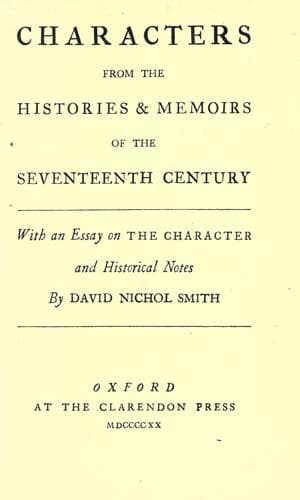
Characters from the Histories & Memoirs of the Seventeenth Century
History
Characters from the Histories & Memoirs of the Seventeenth Century
Great Britain -- Biography; Great Britain -- History -- Stuarts, 1603-1714
of his characters.[9]
His early _History_ had been left behind in England on his sudden
flight. For about four years he was debarred from all intercourse with
his family, but in 1671 the royal displeasure so far relaxed that his
second son, Laurence, was granted a pass to visit him, and he brought
the manuscript that had been left untouched for twenty years. They met
in June at Moulins, which was to be Clarendon's home till April 1674.
Once the old and the new work were both in his hands, he cast his
great _History of the Rebellion_ in its final form, and thus 'finished
the work which his heart was most set upon'. In June 1672 he turned
to the 'Continuation of his Life', which deals with his Chancellorship
and his fall, and was not intended 'ever for a public view, or for
more than the information of his children'. As its conclusion shows,
it was his last work to be completed, but while engaged on it he found
time to write much else, including his reply to Hobbes's _Leviathan_.
'In all this retirement', he could well say, in a passage which reads
like his obituary, 'he was very seldom vacant, and then only when he
was under some sharp visitation of the gout, from reading excellent
books, or writing some animadversions and exercitations of his own,
as appears by the papers and notes which he left.' The activity of
these years of banishment is remarkable in a man who had turned sixty
and had passed through about thirty years of continuous storm. His
intellectual vitality was unimpaired. The old English jollity that
Evelyn had remarked in him in happier if more difficult days had gone,
but the even temper from which it had sprung still remained. He was at
his best as a writer then; writing was never an effort to him, but in
his exile it was an exercise and recreation. He could have said with
Dryden that 'what judgment I had increases rather than diminishes; and
thoughts, such as they are, come crowding in so fast upon me, that my
only difficulty is to choose or to reject'.
He was still in hopes that he would be allowed to return to England,
to die in his own country and among his children. 'Seven years',
he said, 'was a time prescribed and limited by God himself for the
expiration of some of his greatest judgements.'[10] In the seventh
year of his banishment he left Moulins for Rouen, so as to be nearer
home. His hopes were vain. He died at Rouen on December 9, 1674.[11]
His body was brought to England for burial in Westminster.
* * * * *
Public-domain text, read in full here on John Shaqi.
Reviews
Reviews
No reviews yet
Be the first to share your thoughts on this work.
Join the Discussion
Join the discussion
Sign in to leave a comment or review.
Sign InorCreate an account