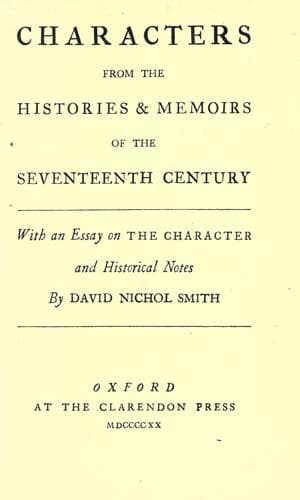
Characters from the Histories & Memoirs of the Seventeenth Century
History
Characters from the Histories & Memoirs of the Seventeenth Century
Great Britain -- Biography; Great Britain -- History -- Stuarts, 1603-1714
Clarendon had been interested in the study of character all his
life. His earliest work was 'The Difference and Disparity between the
Estates and Conditions of George Duke of Buckingham and Robert Earl of
Essex'. Sir Henry Wotton had written observations on these statesmen
'by way of parallel', and Clarendon pointed out as a sequel wherein
they differed. It is a somewhat laboured composition in comparison
with his later work, a young man's careful essay that lacks the
confidence that comes with experience, but it shows at an early stage
the talents which knowledge and practice were to develop into mastery.
The school in which he learned most was the circle of his friends. Few
men can have owed more to their friends than he did, or have been more
generous in acknowledging the debt. He tells us he was often heard to
say that 'next the immediate blessing and providence of God Almighty,
which had preserved him throughout the whole course of his life
(less strict than it ought to have been) from many dangers and
disadvantages, in which many other young men were lost, he owed
all the little he knew, and the little good that was in him, to the
friendships and conversation he had still been used to, of the most
excellent men in their several kinds that lived in that age; by whose
learning, and information, and instruction, he formed his studies,
and mended his understanding, and by whose gentleness and sweetness
of behaviour, and justice, and virtue, and example, he formed his
manners, subdued that pride and suppressed that heat and passion he
was naturally inclined to be transported with.' He used often to say,
he continues, that 'he never was so proud, or thought himself so good
a man, as when he was the worst man in the company'. He cultivated
his friendships, it is true, with an eye to his advancement; but it
is equally true that he had a nature which invited friendships. He
enjoyed to the full the pleasure of living and seeing others live,
and a great part of his pleasure consisted in observing how men
differed in their habits and foibles. He tells how Ben Jonson did
not understand why young Mr. Hyde should neglect the delights of his
company at the call of business; how Selden, with all his stupendous
learning, was never more studious of anything than his ease; how
Earle gave a wrong impression by the negligence of his dress and
mien, whereas no man was more wary and cultivated in his behaviour and
discourse; how Chillingworth argued for the pleasure of arguing and
thereby irritated his friends and at last grew confident of nothing;
how Hales, great in scholarship but diminutive in stature, liked to be
by himself but had a very open and pleasant conversation in congenial
company; how Waller nursed his reputation for ready wit by seeming
to speak on the sudden what he had thoroughly considered. In all his
accounts of the friends of his youth Clarendon is in the background,
but we picture him moving among them at ease, conscious of his
Public-domain text, read in full here on John Shaqi.
Reviews
Reviews
No reviews yet
Be the first to share your thoughts on this work.
Join the Discussion
Join the discussion
Sign in to leave a comment or review.
Sign InorCreate an account