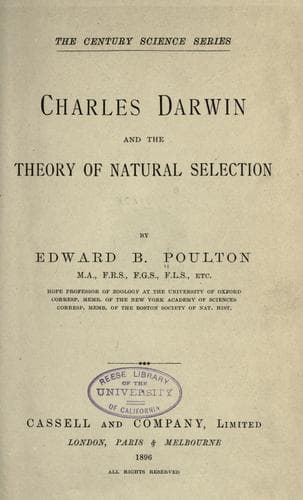
Charles Darwin and the Theory of Natural Selection — John Shaqi
Charles Darwin and the Theory of Natural SelectionPoulton, Edward Bagnall, Sir
Science
Charles Darwin and the Theory of Natural Selection
Poulton, Edward Bagnall, Sir
Darwin, Charles, 1809-1882; Natural selection
Among his numerous observations and discoveries during the voyage,
those which appear to stand out in his mind so that he quotes them
in his “Autobiography” are--the explanation of the forms of coral
islands, the geological structure of St. Helena and other islands, and
the relations between the animals and plants of the several Galapagos
islands to each other and to those of South America. His letters and
the collections which he sent home attracted much attention; and
Sedgwick told Dr. Darwin that his son would take a place among the
leading scientific men. When Darwin heard this from his sisters, he
says, “I clambered over the mountains of Ascension with a bounding
step, and made the volcanic rocks resound under my geological hammer.”
His letters during the voyage are full of enthusiasm and of longing to
return to his family and friends.
There was the same conflict between the naval and scientific
departments of the _Beagle_ on the untidiness of the decks which was
afterwards repeated on the _Challenger_, where I have been told that
one of the naval authorities used to say, with resigned disgust, “Oh,
no, we’re not a man-of-war, we’re only a ---- dredger!”
In the course of the voyage the following countries and islands were
visited in the order given:--The Cape de Verde Islands, St. Paul’s
Rocks, Fernando Noronha, South America (including the Galapagos
Archipelago, the Falkland Islands, and Tierra del Fuego), Tahiti, New
Zealand, Australia, Tasmania, Keeling Island, Maldive Coral Atolls,
Mauritius, St. Helena, Ascension. Brazil was then visited again for a
short time, the _Beagle_ touching at the Cape de Verde Islands and the
Azores on the voyage home.
Darwin says, concerning the intellectual effect of his work during the
voyage:--
“That my mind became developed through my pursuits during the
voyage is rendered probable by a remark made by my father, who
was the most acute observer whom I ever saw, of a sceptical
disposition, and far from being a believer in phrenology; for on
first seeing me after the voyage he turned round to my sisters,
and exclaimed, ‘Why the shape of his head is quite altered!’”
(_l. c._, pp. 63, 64).
CHAPTER IV.
CAMBRIDGE--LONDON--WORK UPON THE COLLECTIONS--MARRIAGE--GEOLOGICAL
WORK--JOURNAL OF THE VOYAGE--CORAL REEFS--FIRST RECORDED THOUGHTS ON
EVOLUTION (1837–42).
Public-domain text, read in full here on John Shaqi.
Reviews
Reviews
No reviews yet
Be the first to share your thoughts on this work.
Join the Discussion
Join the discussion
Sign in to leave a comment or review.
Sign InorCreate an account