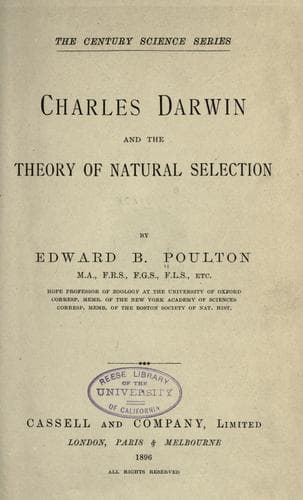
Charles Darwin and the Theory of Natural SelectionPoulton, Edward Bagnall, Sir
Science
Charles Darwin and the Theory of Natural Selection
Poulton, Edward Bagnall, Sir
Darwin, Charles, 1809-1882; Natural selection
Darwin reached England October 2nd, 1836, and was home at Shrewsbury
October 5th (according to his Letters; the 4th is the date given by
Francis Darwin in the “Life and Letters”). The two years and three
months which followed he describes as the most active ones he ever
spent. After visiting his family, he stayed three months in Cambridge,
working at his collection of rocks, writing his “Naturalist’s Voyage,”
and one or two scientific papers. He then (March 7th, 1837) took
lodgings in 36, Great Marlborough Street, London, where he remained
until his marriage, January 29th, 1839. The apathy of scientific
men--even those in charge of museums--caused him much depression,
and he found great difficulty in getting specialists to work out his
collections, although the botanists seem to have been keener than the
zoologists.
The commencement of his London residence is of the deepest interest,
as the time at which he began to reflect seriously on the origin of
species. Thus he says in the “Autobiography”:--“In July I opened my
first note-book for facts in relation to the Origin of Species, about
which I had long reflected, and never ceased working for the next
twenty years.” Furthermore, his pocket-book for 1837 contained the
words:--“In July opened first note-book on Transmutation of Species.
Had been greatly struck from about the month of previous March” (he was
then just over twenty-eight years old) “on character of South American
fossils, and species on Galapagos Archipelago. These facts (especially
latter) origin of all my views.” It is, perhaps, worth while to
explain in greater detail the nature of this evidence which appealed
so strongly to Darwin’s mind. The Edentata (sloths, ant-eaters,
armadilloes, etc.) have their metropolis in South America, and in the
later geological formations of this country the skeletons of gigantic
extinct animals of the same order (Megatherium, Mylodon, Glyptodon,
etc.) are found; and Darwin was doubtless all the more impressed by
discovering such remains for himself. In his “Autobiography” he says:
“During the voyage of the _Beagle_ I had been deeply impressed by
discovering in the Pampean formation great fossil animals covered with
armour like that on existing armadilloes;...”
Darwin was thus led to conclude that there was some genetic connection
between the animals which have succeeded each other in the same
district; for in a theory of destructive cataclysms, followed by
re-creations--or, indeed, in any theory of special creation--there
seemed no adequate reason why the successive forms should belong
to the same order. In his “Naturalist’s Voyage Round the World” he
says, speaking of this subject: “This wonderful relationship in the
same continent between the dead and the living will, I do not doubt,
hereafter throw more light on the appearance of organic beings on our
earth, and their disappearance from it, than any other class of facts”
(p. 173 in the third edition).
[Sidenote: THE GALAPAGOS.]
Public-domain text, read in full here on John Shaqi.
Reviews
Reviews
No reviews yet
Be the first to share your thoughts on this work.
Join the Discussion
Join the discussion
Sign in to leave a comment or review.
Sign InorCreate an account