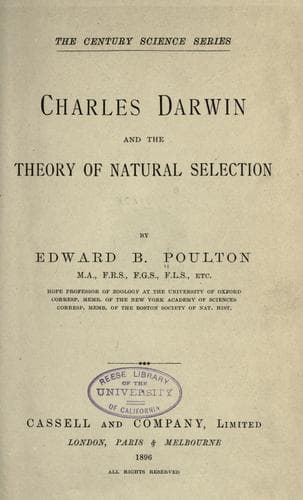
Charles Darwin and the Theory of Natural SelectionPoulton, Edward Bagnall, Sir
Science
Charles Darwin and the Theory of Natural Selection
Poulton, Edward Bagnall, Sir
Darwin, Charles, 1809-1882; Natural selection
The other class of evidence which impressed him even more strongly
was afforded by the relations between the animals and plants of the
several islands of the Galapagos Archipelago and between those of
the Archipelago and of South America, nearly 600 miles to the East.
Although the inhabitants of the separate islands show an astonishing
amount of peculiarity, the species are nearly related, and also exhibit
American affinities. Concerning this, Darwin writes in his “Voyage”
(p. 398 in the third edition): “Reviewing the facts here given, one
is astonished at the amount of creative force--if such an expression
may be used--displayed on these small, barren, and rocky islands; and
still more so at its diverse and yet analogous action on points so near
each other.” Here, too, the facts were unintelligible on a theory of
separate creation of species, but were at once explained if we suppose
that the inhabitants were the modified descendants of species which
had migrated from South America--the migrations to the Archipelago and
between the separate islands being rendered extremely rare from the
depth of the sea, the direction of the currents, and the absence of
gales. In this way time for specific modification was provided before
the partially modified form could interbreed with the parent species
and thus lose its own newly-acquired characteristics.
Although Darwin made these observations on the _Beagle_, they
required, as Huxley has suggested (Obituary [1888], “Darwiniana”:
Collected Essays, vol. ii., pp. 274–275. London, 1893), careful and
systematic working out before they could be trusted as a basis on
which to speculate; and this could not be done until the return home.
The following letter written by Darwin to Dr. Otto Zacharias in 1877
confirms this opinion. It was sent to Huxley by Francis Darwin, and is
printed in “Darwiniana” (_l. c._, p. 275):--
“When I was on board the ‘Beagle,’ I believed in the permanence
of species, but, as far as I can remember, vague doubts
occasionally flitted across my mind. On my return home in the
autumn of 1836, I immediately began to prepare my journal for
publication, and then saw how many facts indicated the common
descent of species, so that in July, 1837, I opened a note-book
to record any facts which might bear on the question. But I did
not become convinced that species were mutable until I think two
or three years had elapsed.”
It is interesting to note that both the lines of evidence which
appealed to Darwin so strongly, point to evolution, but not to any
causes of evolution. The majority of mankind were only convinced of
this process when some conception as to its causes had been offered to
them; Darwin took the more logical course of first requiring evidence
that the process takes place, and then inquiring for its causes.
[Sidenote: EARLY NOTES ON SPECIES.]
Public-domain text, read in full here on John Shaqi.
Reviews
Reviews
No reviews yet
Be the first to share your thoughts on this work.
Join the Discussion
Join the discussion
Sign in to leave a comment or review.
Sign InorCreate an account