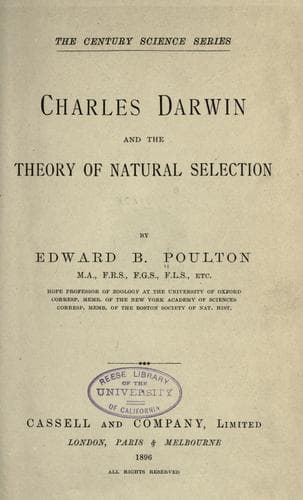
Charles Darwin and the Theory of Natural SelectionPoulton, Edward Bagnall, Sir
Science
Charles Darwin and the Theory of Natural Selection
Poulton, Edward Bagnall, Sir
Darwin, Charles, 1809-1882; Natural selection
But fertility of imagination alone is insufficient for the highest
achievement in poetry, history, or science; for in all these subjects
the strictest self-criticism and the soundest judgment are necessary
in order to ensure that the results are an advance in the direction
of the truth. A delicately-adjusted balance between the powers of
imagination and the powers which hold imagination in check, is
essential in the historian who is to provide us with a picture of a
past age, which explains the mistaken impression gained by a more or
less prejudiced observer who saw but a small part of it from a limited
standpoint, and has handed down his impression to us. A poem which
sheds new light upon the relation between mind and mind, requires to
be tested and controlled by constant and correct observation, like a
hypothesis in the domain of the natural sciences.
It is probable, then, that the secret of Darwin’s strength lay in the
perfect balance between his powers of imagination and those of accurate
observation, the creative efforts of the one being ever subjected to
the most relentless criticism by the employment of the other. We shall
never know, I have heard Professor Michael Foster say, the countless
hypotheses which passed through the mind of Darwin, and which, however
wild and improbable, were tested by an appeal to Nature, and were then
dismissed for ever.
Darwin’s estimate of his own powers is given with characteristic
candour and modesty in the concluding paragraph of his “Autobiography”
(“Life and Letters,” 1887, p. 107):--
“Therefore my success as a man of science, whatever this
may have amounted to, has been determined, as far as I can
judge, by complex and diversified mental qualities and
conditions. Of these, the most important have been--the love
of science--unbounded patience in long reflecting over any
subject--industry in observing and collecting facts--and a fair
share of invention as well as of common sense. With such moderate
abilities as I possess, it is truly surprising that I should have
influenced to a considerable extent the belief of scientific men
on some important points.”
We also know from other sources that Darwin looked upon the creative
powers as essential to scientific progress. Thus he wrote to Wallace
in 1857: “I am a firm believer that without speculation there is no
good and original observation.” He also says in the “Autobiography”:
“I have steadily endeavoured to keep my mind free so as to give up any
hypothesis, however much beloved (and I cannot resist forming one on
every subject), as soon as facts are shown to be opposed to it.”
[Sidenote: VALUE OF HYPOTHESIS.]
Public-domain text, read in full here on John Shaqi.
Reviews
Reviews
No reviews yet
Be the first to share your thoughts on this work.
Join the Discussion
Join the discussion
Sign in to leave a comment or review.
Sign InorCreate an account