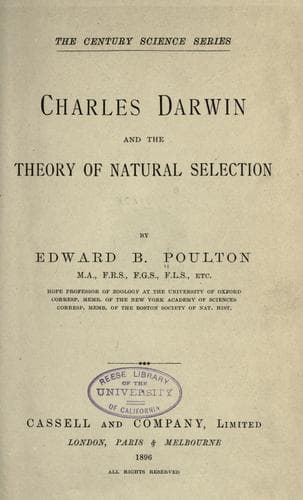
Charles Darwin and the Theory of Natural SelectionPoulton, Edward Bagnall, Sir
Science
Charles Darwin and the Theory of Natural Selection
Poulton, Edward Bagnall, Sir
Darwin, Charles, 1809-1882; Natural selection
I have thought it worth while to insist thus strongly on the high value
attached by Darwin to hypothesis, controlled by observation, in view
of certain recent attacks upon this necessary weapon for scientific
advance. Thus Bateson, in his “Materials for the Study of Variation”
(London, 1894), p. 7, says: “In the old time the facts of Nature
were beautiful in themselves and needed not the rouge of speculation
to quicken their charm, but that was long ago before Modern Science
was born.” The author does not specify the period in the history of
science when discovery proceeded without hypothesis. A study of the
earlier volumes of the _Philosophical Transactions_ reveals a far
greater interest in speculation than in the facts of Nature. We can
hardly call those ages anything but speculative which received with
approval the suggestions that geese were developed from barnacles which
grew upon trees; that swallows hibernated at the bottom of lakes;
that the Trade-winds were due to the breath of a sea-weed. Bateson’s
statement requires to be reversed in order to become correct. Modern
science differs from the science of long ago in its greater attention
to the facts of Nature and its more rigid control over the tendency
to hypothesis; although hypothesis remains, and must ever remain, as
the guide and inspirer of observation and the discovery of fact.[A]
Although Darwin has kindled the imagination of hundreds of workers, and
has thus been the cause of an immense amount of speculation, science
owes him an even larger debt for the innumerable facts discovered under
the guidance of this faculty.
CHAPTER II.
BOYHOOD--EDINBURGH--CAMBRIDGE (1817–31).
Of Darwin’s boyhood and school-life we only know the facts given in his
brief “Autobiography,” written when he was sixty-seven, together with
those collected by his son Francis and appended in the form of notes.
He first went to Mr. Case’s day-school in Shrewsbury in 1817, the year
of his mother’s death. At this time, although only eight years old, his
interest in natural history and in collecting was well established.
“The passion for collecting, which leads a man to be a systematic
naturalist, a virtuoso, or a miser, was very strong in me, and was
clearly innate, as none of my sisters or brother had this taste.”
In the following year he went to Dr. Butler’s school in Shrewsbury,
where he remained seven years. He does not appear to have profited
much by the classical instruction which at that time received
almost exclusive attention. His interest seems to have been chiefly
concentrated upon sport; but whenever a subject attracted him he
worked hard at it, and it is probable that he would have conveyed a
very different impression of his powers to the masters and his father
if scientific subjects had been taught, as they are now to a moderate
extent in many schools.
Public-domain text, read in full here on John Shaqi.
Reviews
Reviews
No reviews yet
Be the first to share your thoughts on this work.
Join the Discussion
Join the discussion
Sign in to leave a comment or review.
Sign InorCreate an account