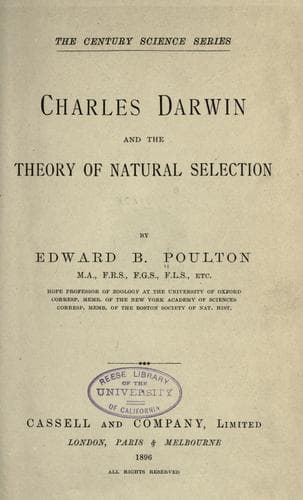
Charles Darwin and the Theory of Natural SelectionPoulton, Edward Bagnall, Sir
Science
Charles Darwin and the Theory of Natural Selection
Poulton, Edward Bagnall, Sir
Darwin, Charles, 1809-1882; Natural selection
That he was a keen observer for his age is clear from the fact that,
when he was only ten, he was much interested and surprised to notice
that the insects he found on the Welsh coast were different from those
in Shropshire. His most valuable education was received out of school
hours--collecting, and working at chemistry with his brother Erasmus,
although this latter study drew down upon him the rebukes of Dr. Butler
for wasting time on such useless subjects.
[Sidenote: AT EDINBURGH.]
He was removed from school early, and in 1825 went to Edinburgh to
study medicine--a subject for which he seemed to be unfitted by nature.
The methods of instruction by lectures did not benefit him; he was
disgusted at dissection, and could not endure to witness an operation.
And yet here it was evident, as it became afterwards at Cambridge,
that Darwin--although seeming to be by no means above the average when
judged by ordinary standards--possessed in reality a very remarkable
and attractive personality. There can be no other explanation of the
impression he made upon distinguished men who were much older than
himself, and the friendships he formed with those of his own age who
were afterwards to become eminent.
Thus at Edinburgh he was well acquainted with Dr. Grant and Mr.
Macgillivray, the curator of the museum, and worked at marine zoology
in company with the former. Here, too, in 1826, he made his first
scientific discovery, and read a paper before the Plinian Society,
proving that so-called eggs of Flustra were in reality free-swimming
larvæ. And it is evident from his “Autobiography” that he took every
opportunity of hearing and learning about scientific subjects.
Darwin’s love of sport remained as keen as ever at this period and at
Cambridge, and he speaks with especial enthusiasm of his visits in the
autumn to Maer, the home of his uncle, Josiah Wedgwood, who afterwards
exerted so important an influence upon his life.
[Sidenote: AT CAMBRIDGE.]
After Darwin had been at Edinburgh for two sessions, his father
realised that he did not like the thought of the medical profession,
and suggested that he should become a clergyman. With this intention
he was sent to Cambridge in the beginning of 1828, after spending some
months in recovering the classics he had learnt at school.
He joined Christ’s College, and passed his final examination in
January, 1831, being tenth in the list of those who do not seek
honours. The immense, and in many respects disastrous, development
of the competitive examination system since that time has almost
banished from our universities the type of student represented by
Darwin--the man who takes the easiest road to a degree and obtains it
with the minimum of effort, but who all the time is being benefited by
residence, studying, without any thought of examinations, the subjects
which are of special interest to him, and seeking personal contact
with older men who have reached the highest eminence in those subjects.
Public-domain text, read in full here on John Shaqi.
Reviews
Reviews
No reviews yet
Be the first to share your thoughts on this work.
Join the Discussion
Join the discussion
Sign in to leave a comment or review.
Sign InorCreate an account