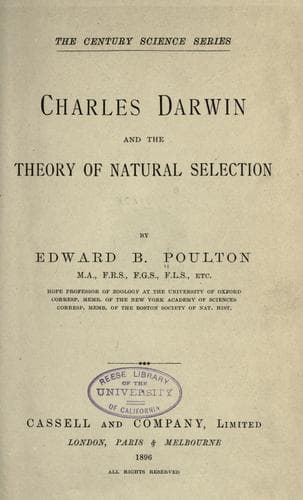
Charles Darwin and the Theory of Natural SelectionPoulton, Edward Bagnall, Sir
Science
Charles Darwin and the Theory of Natural Selection
Poulton, Edward Bagnall, Sir
Darwin, Charles, 1809-1882; Natural selection
He seems to have led a somewhat double life at Cambridge, his
intense love of sport taking him into a pleasure-loving set, while
his intellectual interests made him the intimate friend of Whitley,
who became Senior Wrangler, and of Professor Henslow, to whom he
was introduced by his second cousin, W. Darwin Fox, who also first
interested him in entomology. He became so keen a collector of beetles
that his successes and experiences in this direction seem to have
impressed him more deeply than anything else at Cambridge. Entomology,
and especially beetles, form the chief subject of those of his
Cambridge letters which have been recovered.
Darwin’s friendship with Henslow, which was to have a most important
effect on his life, very soon deepened. They often went long walks
together, so that he was called “the man who walks with Henslow.” This
fact and the subsequent rapidly formed intimacy with Professor Adam
Sedgwick, indicate that he was remarkable among the young men of his
standing.
One of his undergraduate friends, J. M. Herbert, afterwards County
Court Judge for South Wales, retained the most vivid recollection of
Darwin at Cambridge, and contributed the following impression of his
character to the “Life and Letters”:--
“It would be idle for me to speak of his vast intellectual powers
... but I cannot end this cursory and rambling sketch without
testifying, and I doubt not all his surviving college friends
would concur with me, that he was the most genial, warm-hearted,
generous and affectionate of friends; that his sympathies were
with all that was good and true; and that he had a cordial
hatred for everything false, or vile, or cruel, or mean, or
dishonourable. He was not only great, but pre-eminently good, and
just, and loveable.”
Two books greatly influenced Darwin--Herschel’s “Introduction to the
Study of Natural Philosophy,” which, he said, “stirred up in me a
burning zeal to add even the most humble contribution to the noble
structure of Natural Science”; and Humboldt’s “Personal Narrative,”
which roused in him the longing to travel--a desire which was soon
afterwards gratified by his voyage in the _Beagle_.
“Upon the whole,” he says, “the three years which I spent at Cambridge
were the most joyful in my happy life; for I was then in excellent
health, and almost always in high spirits.”
After passing his last examination, Darwin had still two terms’
residence to keep, and was advised by Henslow to study geology. To
this end Henslow asked Sedgwick to allow Darwin to go with him on a
geological excursion in North Wales in August, 1831. He thus gained
experience which was of the utmost value during the voyage of the
_Beagle_.
CHAPTER III.
VOYAGE OF THE “BEAGLE” (1831–36).
Public-domain text, read in full here on John Shaqi.
Reviews
Reviews
No reviews yet
Be the first to share your thoughts on this work.
Join the Discussion
Join the discussion
Sign in to leave a comment or review.
Sign InorCreate an account