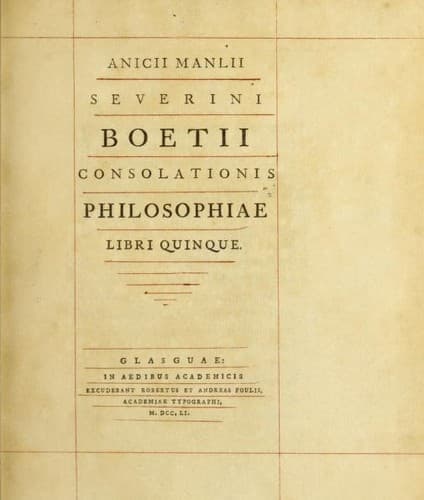
Chaucer's Translation of Boethius's "De Consolatione Philosophiae" — John Shaqi
Chaucer's Translation of Boethius's "De Consolatione Philosophiae"Boethius
ReligionComparative
Chaucer's Translation of Boethius's "De Consolatione Philosophiae"
Boethius
Happiness; Philosophy and religion
(_Chaucer’s Boethius_, pp. 43, 44.)
(1) Quem caduca ista felicitas vehit, vel scit eam, vel nescit
esse mutabilem. Si nescit, quænam beata sors esse potest
ignorantiæ in cæcitate?
(2) Si scit, metuat necesse est, ne amittat, quod amitti posse non
dubitat; quare continuus timor non sinit esse felicem. An vel si
amiserit, negligendum putat? Sic quoque perexile bonum est, quod
æquo animo feratur amissum.
(_Boethius_, lib. ii. prose 4.)
XIII. FORTUNE.
----Fortune
That semeth trewest when she wol bigyle,
. . . . . . . . . . . . .
And, when a wight is from hire whiel ithrowe,
Than laugheth she, and maketh hym the mowe.
(_Troylus and Cryseyde_, bk. iii. st. 254, vol. iv. p. 299.)
She (Fortune) vseþ ful flatryng familarité wiþ hem þat she
enforceþ to bygyle.
(_Chaucer’s Boethius_, p. 30.)
. . . . . . . She lauȝeþ and scorneþ þe wepyng of hem þe
whiche she haþ maked wepe wiþ hir free wille . . . . Yif þat a
wyȝt is seyn weleful and ouerþrowe in an houre.
(_Ib._ p. 33.)
In book v., stanza 260, vol. v. p. 75, Chaucer describes how the soul of
Hector, after his death, ascended ‘up to the holughnesse of the seventhe
spere.’ In so doing he seems to have had before him met. 1, book 4, of
Boethius, where the ‘soul’ is described as passing into the heaven’s
utmost sphere, and looking down on the world below. See _Chaucer’s
Boethius_, p. 110, 111.
Ætas Prima is of course a metrical version of lib. ii. met. 5.
Hampole speaks of the wonderful sight of the Lynx; perhaps he was
indebted to Boethius for the hint. --(See _Boethius_, book 3, pr. 8,
p. 81.)
I have seen the following elsewhere:
(1) Value not beauty, for it may be destroyed by a three days’
fever.
(See _Chaucer’s Boethius_, p. 81.)
(2) There is no greater plague than the enmity of thy familiar
friend.
(See _Chaucer’s_ translation, p. 77.)
* * * * *
Chaucer did not English Boethius second-hand, through any early French
version, as some have supposed, but made his translation with the Latin
original before him.
Jean de Méung’s version, the only early French translation, perhaps,
accessible to Chaucer, is not always literal, while the present
translation is seldom free or periphrastic, but conforms closely to the
Latin, and is at times awkwardly literal. A few passages, taken
haphazard, will make this sufficiently clear.
_Et dolor ætatem jussit inesse suam._ And sorou haþ comaunded his
age to be in me (p. 4).
Et ma douleur {com}ma{n}da a vieillesse
Entrer en moy / ains quen fust hors ieunesse.
_Mors hominum felix, quæ se nec dulcibus annis
Inserit, et mæstis sæpe vocata venit._
Þilke deeþ of men is welful þat ne comeþ not in ȝeres þat ben
swete (i. _mirie_). but comeþ to wrecches often yclepid. (p. 4)
Public-domain text, read in full here on John Shaqi.
Reviews
Reviews
No reviews yet
Be the first to share your thoughts on this work.
Join the Discussion
Join the discussion
Sign in to leave a comment or review.
Sign InorCreate an account