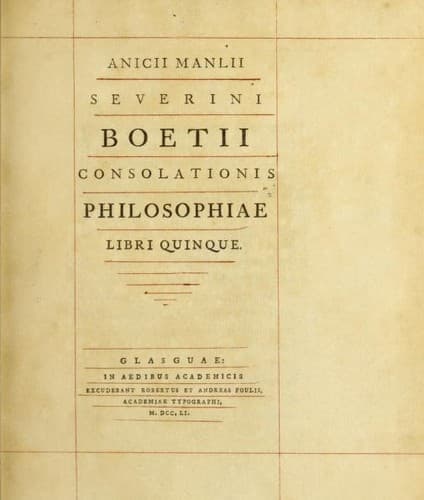
Chaucer's Translation of Boethius's "De Consolatione Philosophiae" — John Shaqi
Chaucer's Translation of Boethius's "De Consolatione Philosophiae"Boethius
ReligionComparative
Chaucer's Translation of Boethius's "De Consolatione Philosophiae"
Boethius
Happiness; Philosophy and religion
X. VULTURES TEAR THE STOMACH OF TITYUS IN HELL.
----Syciphus in Helle,
Whos stomak fowles tyren everemo,
That hyghten volturis.
(_Troylus and Cryseyde_, book i. st. 113, p. 140.)
Þe fowel þat hyȝt voltor þat etiþ þe stomak or þe giser of ticius.
(_Chaucer’s Boethius_, p. 107.)
XI. THE MUTABILITY OF FORTUNE.
For if hire (Fortune’s) whiel stynte any thinge to torne
Thanne cessed she Fortune anon to be.
(_Troylus and Cryseyde_, bk. i. st. 122, p. 142.)
If fortune bygan to dwelle stable. she cesed[e] þan to ben fortune.
(_Chaucer’s Boethius_, p. 32.)
(Compare stanzas 120, 121, p. 142, and stanza 136, p. 146, of ‘Troylus
and Cryseyde’ with pp. 31, 33, 35, and p. 34 of Chaucer’s Boethius.)
At omnium mortalium stolidissime, si manere incipit, fors esse
desistit.
(_Boethius_, lib. ii. prose 1.)
XII. WORLDLY SELYNESSE
. . . . . . . . . . . . . .
Imedled is with many a bitternesse.
Ful angwyshous than is, God woote, quod she,
Condicion of veyn prosperité!
For oyther joies comen nought yfeere,
Or elles no wight hath hem alwey here.
(_Troylus and Cryseyde_, bk. iii. st. 110, p. 258.)
Þe swetnesse of mannes welefulnesse is yspranid wiþ many[e]
bitternesses.
(_Chaucer’s Boethius_, p. 42.)
--ful anguissous þing is þe condicioun of mans goodes. For eyþer
it comeþ al to-gidre to a wyȝt. or ellys it lasteþ not perpetuely.
(_Ib._ p. 41.)
Quam multis amaritudinibus humanæ felicitatis dulcedo respersa
est!
(_Boethius_, lib. ii. prose 4.)
Anxia enim res est humanorum conditio bonorum, et quæ vel nunquam
tota proveniat, vel nunquam perpetua subsistat.
(_Ib._)
O, brotel wele of mannes joie unstable!
With what wight so thow be, or how thow pleye,
Oither he woot that thow joie art muable,
Or woot it nought, it mot ben on of tweyen:
Now if he woot it not, how may he seyen
That he hath veray joie and selynesse,
That is of ignoraunce ay in distresse?
Now if he woote that joie is transitorie,
As every joie of worldly thynge mot fle,
Thanne every tyme he that hath in memorie,
The drede of lesyng maketh hym that he
May in no parfyte selynesse be:
And if to lese his joie, he sette not a myte,
Than semeth it, that joie is worth ful lite.
(_Troylus and Cryseyde_, bk. iii. st. 111, 112, vol. iv. p. 258.)
(1) What man þat þis toumblyng welefulnesse leediþ, eiþer he woot
þat [it] is chaungeable. or ellis he woot it nat. And yif he woot
it not. what blisful fortune may þer be in þe blyndenesse of
ignoraunce.
(2) And yif he woot þat it is chaungeable. he mot alwey ben adrad
þat he ne lese þat þing. þat he ne douteþ nat but þat he may
leesen it. . . . . . For whiche þe continuel drede þat he haþ
ne suffriþ hym nat to ben weleful. Or ellys yif he leese it he
wene[þ] to be dispised and forleten hit. Certis eke þat is a ful
lytel goode þat is born wiþ euene hert[e] whan it is loost.
Public-domain text, read in full here on John Shaqi.
Reviews
Reviews
No reviews yet
Be the first to share your thoughts on this work.
Join the Discussion
Join the discussion
Sign in to leave a comment or review.
Sign InorCreate an account