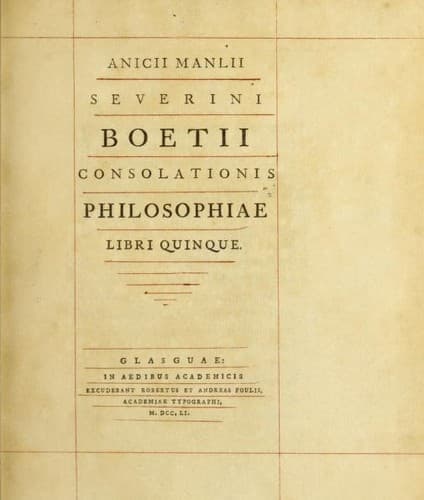
Chaucer's Translation of Boethius's "De Consolatione Philosophiae" — John Shaqi
Chaucer's Translation of Boethius's "De Consolatione Philosophiae"Boethius
ReligionComparative
Chaucer's Translation of Boethius's "De Consolatione Philosophiae"
Boethius
Happiness; Philosophy and religion
Had I had an opportunity of examining the Cambridge MS. carefully
throughout before the work was so far advanced, I should certainly have
selected it in preference to the text now given to the reader. Though
not so ancient as the British Museum MS., it is far more correct in its
grammatical inflexions, and is no doubt a copy of an older and very
accurate text.
The Additional MS. is written by a scribe who was unacquainted with the
force of the final _-e_. Thus he adds it to the preterites of strong
verbs, which do not require it; he omits it in the preterites of weak
verbs where it is wanted, and attaches it to passive participles (of
weak verbs), where it is superfluous. The scribe of the Cambridge MS. is
careful to preserve the final _-e_ where it is a sign (1) of the
definite declension of the adjective; (2) of the plural adjective;
(3) of the infinitive mood; (4) of the preterite of weak verbs; (5) of
present participles;[I-12] (6) of the 2nd pers. pret. indic. of strong
verbs; (7) of adverbs; (8) of an older vowel ending.
The Addit. MS. has frequently _thilk_ (singular and plural), and _-nes_
(in _wrechednes_, &c.), when the Camb. MS. has _thilke_[I-13] and
_-nesse_.
For further differences the reader may consult the numerous collations
at the foot of the page.
If the Chaucer Society obtains that amount of patronage from the
literary public which it deserves, but unfortunately has yet not
succeeded in getting, so that it may be enabled to go on with the great
work which has been so successfully commenced, then the time may come
when I shall have the opportunity of editing the Camb. MS. of Chaucer’s
Boethius for that Society, and lovers of Early English Literature will
have two texts instead of one.
[Footnote I-11: See pages 39, 50, 61, 94, 111, 133, 149, 153,
159.]
[Footnote I-12: In the Canterbury Tales we find participles in
_-yngë_.]
[Footnote I-13: It is nearly always _thilkë_ in the Canterbury
Tales.]
APPENDIX TO INTRODUCTION.
Public-domain text, read in full here on John Shaqi.
Reviews
Reviews
No reviews yet
Be the first to share your thoughts on this work.
Join the Discussion
Join the discussion
Sign in to leave a comment or review.
Sign InorCreate an account