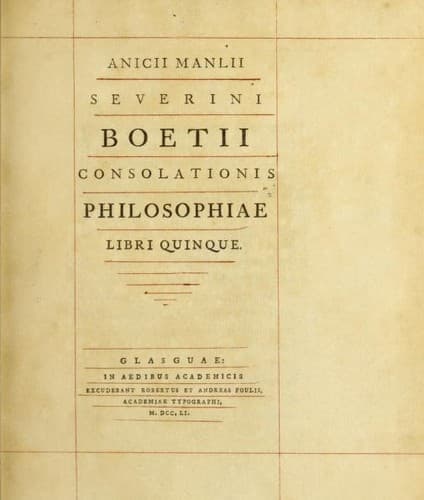
Chaucer's Translation of Boethius's "De Consolatione Philosophiae" — John Shaqi
Chaucer's Translation of Boethius's "De Consolatione Philosophiae"Boethius
ReligionComparative
Chaucer's Translation of Boethius's "De Consolatione Philosophiae"
Boethius
Happiness; Philosophy and religion
The last of the ancients, and one who forms a link between the classical
period of literature and that of the middle ages, in which he was a
favourite author, is Boethius, a man of fine genius, and interesting
both from his character and his death. It is well known that after
filling the dignities of Consul and Senator in the court of Theodoric,
he fell a victim to the jealousy of a sovereign, from whose memory, in
many respects glorious, the stain of that blood has never been effaced.
The _Consolation of Philosophy_, the chief work of Boethius, was written
in his prison. Few books are more striking from the circumstances of
their production. Last of the classic writers, in style not impure,
though displaying too lavishly that poetic exuberance which had
distinguished the two or three preceding centuries, in elevation of
sentiment equal to any of the philosophers, and mingling a Christian
sanctity with their lessons, he speaks from his prison in the swan-like
tones of dying eloquence. The philosophy that consoled him in bonds, was
soon required in the sufferings of a cruel death. Quenched in his blood,
the lamp he had trimmed with a skilful hand gave no more light; the
language of Tully and Virgil soon ceased to be spoken; and many ages
were to pass away, before learned diligence restored its purity, and the
union of genius with imitation taught a few modern writers to surpass in
eloquence the Latinity of Boethius. --(Hallam’s _Literature of Europe_,
i. 2, 4th ed. 1854.)
The Senator Boethius is the last of the Romans whom Cato or Tully could
have acknowledged for their countryman. As a wealthy orphan, he
inherited the patrimony and honours of the Anician family, a name
ambitiously assumed by the kings and emperors of the age; and the
appellation of Manlius asserted his genuine or fabulous descent from a
race of consuls and dictators, who had repulsed the Gauls from the
Capitol, and sacrificed their sons to the discipline of the Republic. In
the youth of Boethius the studies of Rome were not totally abandoned; a
Virgil is now extant, corrected by the hand of a consul; and the
professors of grammar, rhetoric, and jurisprudence, were maintained in
their privileges and pensions by the liberality of the Goths. But the
erudition of the Latin language was insufficient to satiate his ardent
curiosity; and Boethius is said to have employed eighteen laborious
years in the schools of Athens, which were supported by the zeal, the
learning, and the diligence of Proclus and his disciples. The reason and
piety of their Roman pupil were fortunately saved from the contagion of
mystery and magic, which polluted the groves of the Academy, but he
imbibed the spirit, and imitated the method, of his dead and living
masters, who attempted to reconcile the strong and subtle sense of
Aristotle with the devout contemplation and sublime fancy of Plato.
After his return to Rome, and his marriage with the daughter of his
Public-domain text, read in full here on John Shaqi.
Reviews
Reviews
No reviews yet
Be the first to share your thoughts on this work.
Join the Discussion
Join the discussion
Sign in to leave a comment or review.
Sign InorCreate an account