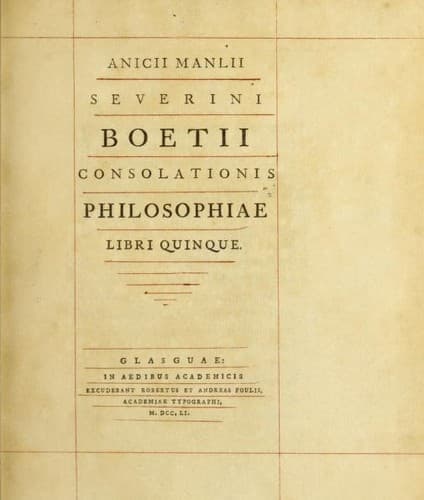
Chaucer's Translation of Boethius's "De Consolatione Philosophiae" — John Shaqi
Chaucer's Translation of Boethius's "De Consolatione Philosophiae"Boethius
ReligionComparative
Chaucer's Translation of Boethius's "De Consolatione Philosophiae"
Boethius
Happiness; Philosophy and religion
friend, the patrician Symmachus, Boethius still continued, in a palace
of ivory and [glass] to prosecute the same studies. The Church was
edified by his profound defence of the orthodox creed against the Arian,
the Eutychian, and the Nestorian heresies; and the Catholic unity was
explained or exposed in a formal treatise by the _indifference_ of three
distinct though consubstantial persons. For the benefit of his Latin
readers, his genius submitted to teach the first elements of the arts
and sciences of Greece. The geometry of Euclid, the music of Pythagoras,
the arithmetic of Nicomachus, the mechanics of Archimedes, the astronomy
of Ptolemy, the theology of Plato, and the logic of Aristotle, with the
commentary of Porphyry, were translated and illustrated by the
indefatigable pen of the Roman senator. And he alone was esteemed
capable of describing the wonders of art, a sun-dial, a water-clock, or
a sphere which represented the motions of the planets. From these
abstruse speculations, Boethius stooped, or, to speak more truly, he
rose to the social duties of public and private life: the indigent were
relieved by his liberality; and his eloquence, which flattery might
compare to the voice of Demosthenes or Cicero, was uniformly exerted in
the cause of innocence and humanity. Such conspicuous merit was felt and
rewarded by a discerning prince: the dignity of Boethius was adorned
with the titles of consul and patrician, and his talents were usefully
employed in the important station of master of the offices.
Notwithstanding the equal claims of the East and West, his two sons were
created, in their tender youth, the consuls of the same year. On the
memorable day of their inauguration, they proceeded in solemn pomp from
their palace to the forum amidst the applause of the senate and people;
and their joyful father, the true Consul of Rome, after pronouncing an
oration in the praise of his royal benefactor, distributed a triumphal
largess in the games of the circus. Prosperous in his fame and fortunes,
in his public honours and private alliances, in the cultivation of
science and the consciousness of virtue, Boethius might have been styled
happy, if that precarious epithet could be safely applied before the
last term of the life of man.
Public-domain text, read in full here on John Shaqi.
Reviews
Reviews
No reviews yet
Be the first to share your thoughts on this work.
Join the Discussion
Join the discussion
Sign in to leave a comment or review.
Sign InorCreate an account